Data Centralization for Impact Investors: A Complete Guide
Picture this: Your impact analyst just spent three days reconciling data from 15 portfolio companies. Financial metrics were pulled from your portfolio management system. Impact data arrived via different Excel templates and Google Forms. Some companies forgot to respond. And when you finally compiled everything, you discovered that three companies misinterpreted the instructions, making the data incomparable.
This bottleneck (aka data fragmentation) isn't just inefficient. It's a barrier to fulfilling your mission.
Research from Impact Capital Managers (ICM) shows that nearly 50% of portfolio companies cite data fragmentation as their top challenge. The median portfolio company spends 20 hours annually on additional investor-requested impact data collection. One fund manager described it bluntly: "Collecting impact data from 37 portfolio companies is a tall order."
In this guide, we’ll explore how to reconcile data living in disconnected silos across financial systems, CRMs, survey platforms, spreadsheets, and email threads. That way, you can make portfolio-level analysis efficient and save staff time across the organization.
Table of Contents:
- Impact Data Centralization FAQ
- How to Implement Impact Data Centralization
- Impact Data Centralization Best Practices for Impact Investors
- Choosing Software for Impact Data Centralization
Impact Data Centralization FAQ
What causes data fragmentation in impact portfolios?
Because impact investing sits at the intersection of traditional finance and diverse social impact sectors, it lacks a single, centralized data registry. Instead, information is scattered across various platforms, proprietary databases, and siloed organizational reports. This fragmentation stems from several challenges:
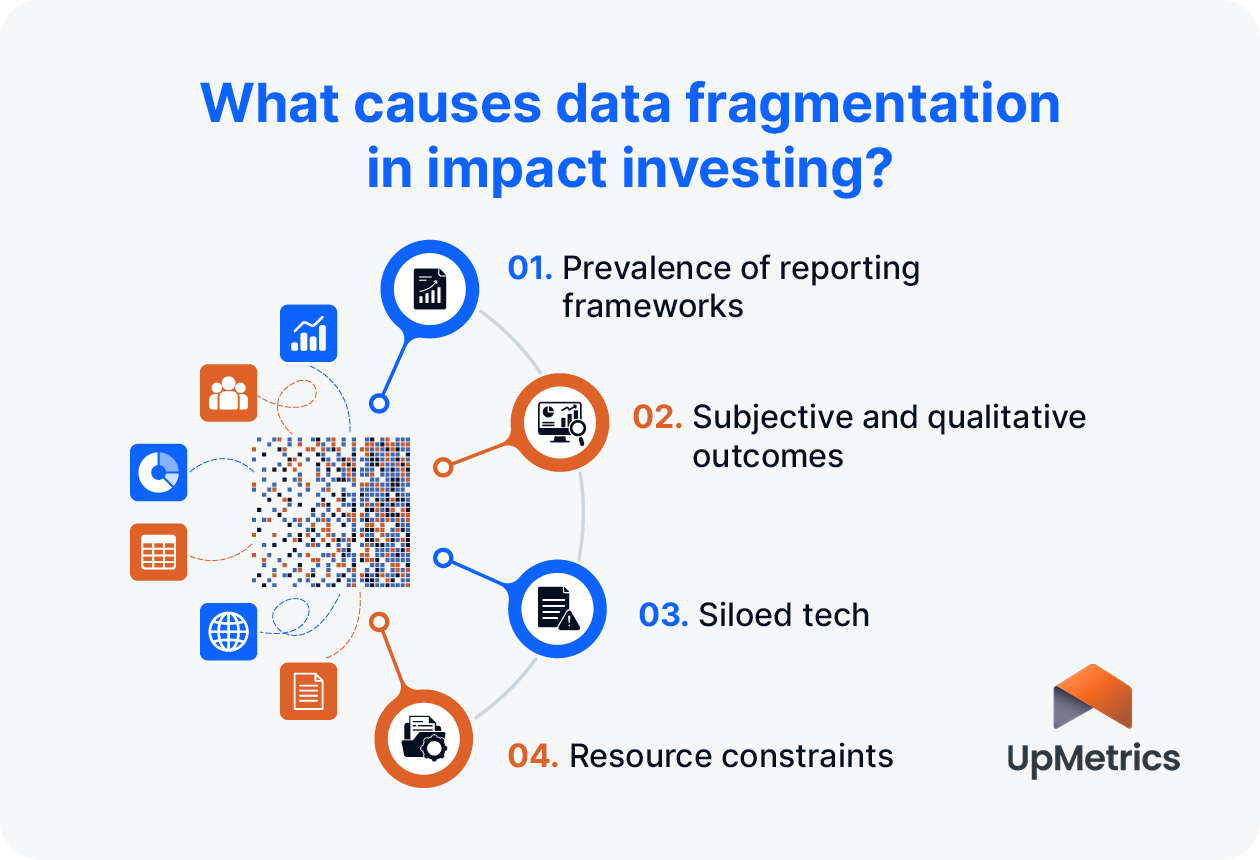
- Prevalence of reporting frameworks: Impact investors have an array of competing standards to keep track of (e.g., IRIS+, SASB, the UN Sustainable Development Goals (SDGs), and GRI), leading companies to report different metrics under different methodologies.
- Subjective and qualitative outcomes: Unlike financial returns, some impacts are inherently qualitative and difficult to standardize into uniform data points.
- Siloed proprietary tech: Many fund managers and institutional investors rely on custom, in-house data management systems that don't communicate with outside platforms, trapping valuable impact data in isolated silos.
- Resource constraints for social organizations: The nonprofits on the ground that actually generate impact often lack the budget, software, or specialized staff required to rigorously track and report complex data metrics.
Beyond external and material challenges, simply not knowing about the importance of data fragmentation can be a significant barrier. That’s why it’s essential to train your team to spread the importance of data centralization for impact investors.
How does data quality affect investment impact reporting?
As stricter regulations like the EU CSRD roll out, thousands of impact investors are being forced to formalize their sustainability metrics, making poor data a major liability. When data is messy or unreliable, it creates real operational risks throughout the entire investment pipeline, such as:
- Fundraising: With data quality cited by 57% of executives as their top ESG challenge, investment committees are increasingly halting deals or walking away if a fund's impact data looks weak.
- Compliance: As mandatory reporting becomes more common, guessed or unverified numbers will no longer pass formal audits, leaving funds exposed to real regulatory penalties.
- Operations: When investors send uncoordinated, complex data requests, they overwhelm the founders on the ground, who end up rushing through data entry just to check a box.
To mitigate these risks, you’ll need to work with your team to build clear, reliable data processes from the start (more on that later). Taking this step protects your investments and keeps your fund competitive in a heavily scrutinized market.
How can investors reduce the reporting burden for founders?
Lightening the reporting load for founders requires more than deleting a few lines from an annual questionnaire. As the Director of Impact at SJF Ventures points out, the real goal should be "[closing] the loop [and] making reporting a two-way conversation rather than just a data extraction process." When you make data useful for the people collecting it, operational issues drop, and the quality of your insights improves dramatically. Follow these quick best practices to get started:
- Provide self-service dashboards. Give your portfolio companies permanent access to automated analytics so they can use the data for their own operations and pitch decks.
- Stick to universal frameworks. Map your custom investor questions to industry-standard formats behind the scenes so founders don't have to manually translate data across multiple formats.
- Automate data collection. Connect your reporting platform directly to the software founders already use (e.g., HR and accounting tools) to eliminate manual data entry entirely.
Turning data collection into a reciprocal relationship naturally drives higher engagement and cleaner results. This simple shift unlocks better insights while keeping your portfolio teams focused on scaling their businesses.
When should impact investors centralize their data?
Not every fund needs to overhaul its reporting infrastructure immediately. But these warning signs indicate you've outgrown your current approach:
- Portfolio size has crossed 15+ companies managed through spreadsheets
- Your team spends more time aggregating than analyzing
- Data quality issues recur constantly with inconsistent definitions and missing responses
- Stakeholder pressure is mounting for more sophisticated, real-time reporting
- Growth trajectory demands better infrastructure as you add portfolio companies or launch new funds
How to Implement Impact Data Centralization
Once you’ve decided it’s right to centralize your data, your project will likely follow these key stages:
Stage 1: Audit (2-4 weeks)
Map where data currently lives, inventory every metric you collect, assess data quality, and document current workflows. Most funds discover upwards of 15 different places where impact data lives, along with metrics they collect but never actually use.
Stage 2: Standardize (4-6 weeks)
Inconsistent definitions make aggregated numbers meaningless. Create a data dictionary with precise definitions for each metric. For instance, when you ask for "jobs created," do portfolio companies include contractors? Part-time roles?
During this process, design your core metric set (i.e., five-10 metrics every portfolio company reports), establish reporting cadence, and create validation rules.
Stage 3: Migrate (8-12 weeks)
Start with a pilot of three to five portfolio companies representing different use cases. Test your framework, gather feedback, and refine before full rollout. Then, create data connections to existing systems, develop your historical data migration strategy, create training materials, and run old and new systems in parallel for one or two cycles to validate accuracy.
Stage 4: Validate (4-6 weeks)
Compare integrated data against source systems, conduct user acceptance testing with both your team and portfolio companies, refine processes based on feedback, and establish ongoing feedback loops.
Stage 5: Activate (Ongoing)
Roll out to the full portfolio in manageable waves of five to 10 companies. While rolling out your process, build a reporting infrastructure with standard dashboards and automated alerts, and enable portfolio company self-service so reporting serves their strategic needs, not just yours. Over the long-term, establish regular analysis rhythms (monthly reviews for early warnings, quarterly for deeper trends, annual for strategic insights).
Impact Data Centralization Best Practices for Impact Investors
Effective data centralization for impact investors is primarily a governance and standards problem. Follow these best practices to start off on the right foot:
Choose the Right Centralization Approach
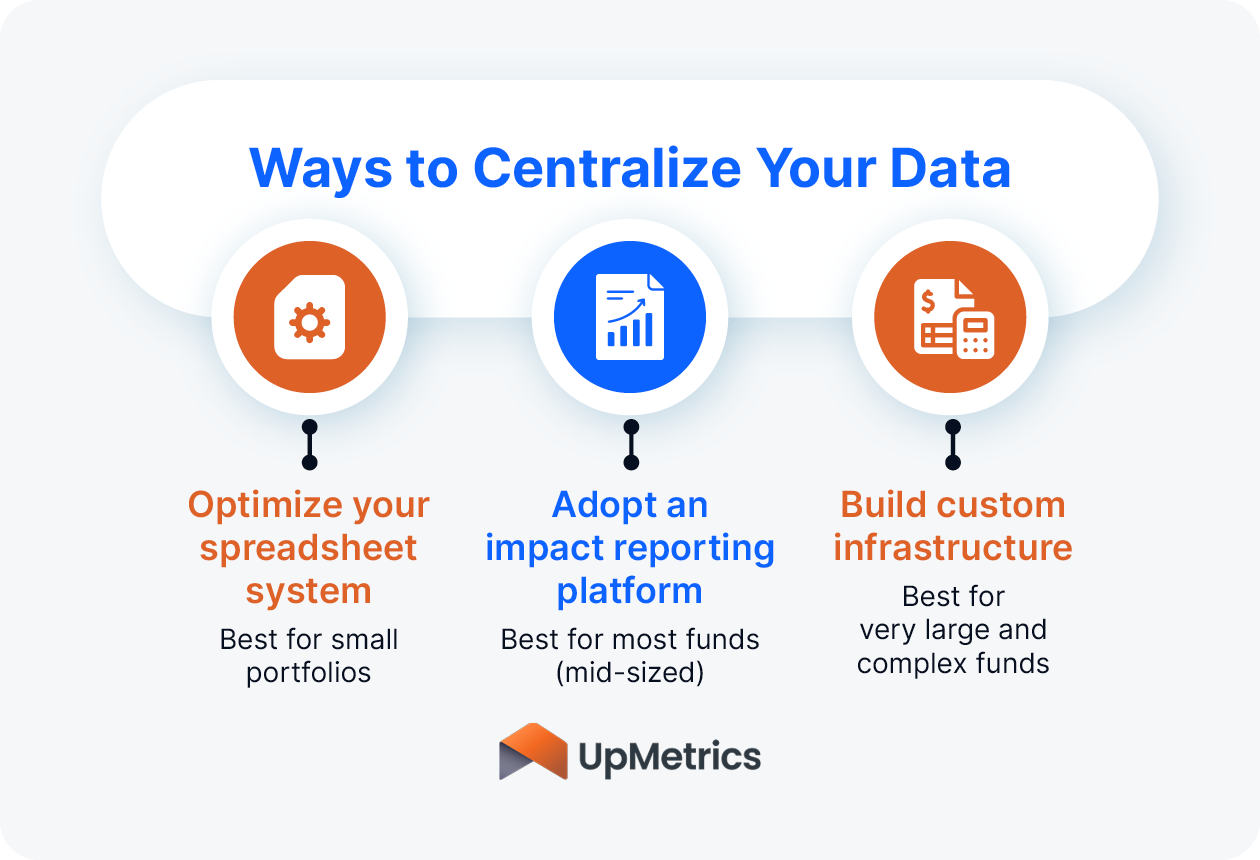
Once you've decided to centralize, you face three options.
- Optimize your spreadsheet system. This option works only for very small portfolios (under 10 companies) with standardized metrics. The fundamental problems don't go away; spreadsheets still don't scale, version control remains problematic, and manual effort stays high.
- Adopt a purpose-built platform. This option works best for most impact investors managing 15+ portfolio companies. You're operational in weeks rather than years, benefit from proven workflows, and get ongoing updates without a maintenance burden. Look for platforms that offer flexible data collection, portfolio company self-service, real integration (not just CSV imports), and real-time dashboards. Ensuring the platform provider also offers high-quality customer support and service options is also a good thing to look for.
- Build custom infrastructure. This option makes sense for very large funds ($500M+ AUM) with truly unique workflows and 12-18 month timelines. Expect $200K-$500K for the initial build, plus $50K-$100K in annual maintenance. Most funds find this is over-engineering the problem.
Other Best Practices
- Standardize data before you collect. Agree on a common taxonomy (e.g., shared fields, units, naming conventions, and a documented data dictionary) before any data flows in. Provide structured reporting templates with validated fields so data arrives clean and means the same thing regardless of its origin. Reference established frameworks like IRIS+ where possible. The less transformation required on ingestion, the more trustworthy your central store.
- Map your sources and establish a single source of truth. Identify every place data lives (such as spreadsheets, survey tools, CRMs, third-party databases, and financial platforms) and designate one system as the authoritative record for each data type. That way, you resolve ambiguity structurally, not case by case.
- Integrate datasets. Manual data entry is the biggest source of inconsistency. Connect directly to source systems via API or standardized exports wherever possible, and apply validation rules at the point of entry to catch errors early. Log every submission, modification, and restatement with a timestamp and owner so you can reconstruct any point-in-time view and maintain a reliable audit trail.
- Keep governance and access control in mind. Assign a data steward accountable for the ongoing health of your central store. Define role-based access tiers, such as who sees their own data only, who sees aggregated views, and who has full access, and enforce them technically. Remember to schedule regular audits and create feedback loops with data submitters when entries fail validation.
- Design for long-term use. You’ll spend a lot of resources on this project, so you want to ensure it lasts as long as possible. Align your pipeline to your actual reporting cadence and stakeholder obligations, whether that's board decks, funder deliverables, or regulatory disclosures. When definitions or platforms change, document the break in the data series so historical comparisons remain valid.
Choosing Software for Impact Data Centralization
Selecting the right software to centralize your impact data is one of the most critical operational decisions a fund can make. Unlike traditional software that only tracks financial metrics, impact investing requires a platform capable of handling complex, nuanced outcome data alongside financial performance.
When evaluating vendors, you need a system that maximizes data integrity and minimizes bottlenecks. To ensure your centralization efforts are successful, look for a platform with:
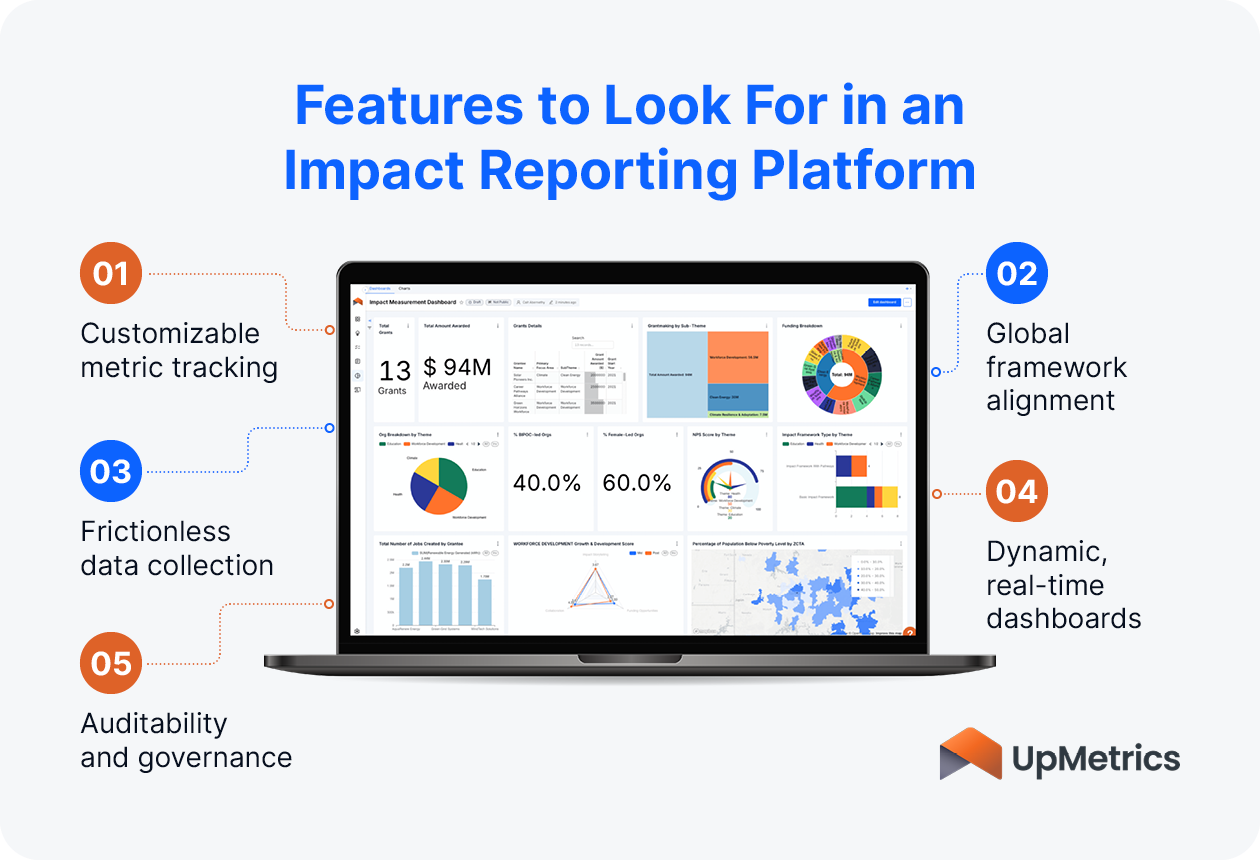
- Customizable metric tracking: The platform must allow you to track both quantitative data (e.g., revenue, carbon emissions) and qualitative narratives (e.g., founder stories, community impact), adapting to the unique KPIs of your specific portfolio.
- Global framework alignment: Look for out-of-the-box alignment with standardized impact frameworks like the UN SDGs, IRIS+, and the Impact Management Project (IMP), allowing you to seamlessly map your custom metrics to global standards.
- Frictionless data collection: The impact reporting platform should significantly reduce portfolio company reporting fatigue. It needs intuitive data entry portals, automated reminders, and the ability to pull data directly from source systems to eliminate manual spreadsheet chasing.
- Dynamic, real-time dashboards: You need the ability to visualize your impact instantly. The platform should offer robust reporting tools that let you slice data by sector, geography, or demographics, making it easy to share compelling, up-to-date insights with LPs and stakeholders.
- Auditability and governance: To protect against impact washing, the platform must maintain a clear audit trail. You need to see exactly when data was submitted, who approved it, and maintain historical records for compliance and transparency.
The Best Impact Reporting Platform: UpMetrics
While many platforms offer a patchwork of these features, UpMetrics stands out as the top purpose-built solution for impact investors. This impact reporting platform is specifically designed to handle the exact challenges of impact data centralization. By combining simple data collection with powerful, framework-aligned analytics, UpMetrics provides the most comprehensive, reliable, and user-friendly platform on the market, empowering both your fund and your founders to measure your most essential metrics.
Wrapping Up: Moving From Compliance to Intelligence
Mitigating data fragmentation in impact portfolios is about so much more than database cleansing. Centralizing impact data helps you build the foundation for a learning organization that identifies opportunities in real time, supports portfolio companies with insights, and demonstrates impact with confidence.
Ready to take the next step? Schedule a conversation to explore how UpMetrics helps impact investors move from fragmented spreadsheets to integrated portfolio intelligence.