Impact Reports: What They Are + How to Make Yours Exemplary
Imagine you're chatting with a major donor or investor who expresses skepticism that their contributions have truly made a difference for your beneficiaries. You could offer generic examples of how donations have pushed your work forward. But wouldn't it be more effective to speak to the major donor's individual impact?
An impact report communicates your organization's progress toward its goals and can take many forms, from a virtual display to a section in an annual report. It's a useful tool for demonstrating accountability to your stakeholders and telling your organization's story.
However, truly transformative impact reporting goes beyond creating one resource. It’s an ongoing process in which you communicate with stakeholders to involve them more actively in your progress.
In this guide, we'll dig deeper into impact reporting and the steps your organization can take to improve your own report and tactics. We'll cover:
- Impact Reporting FAQs
- Benefits of Creating an Impact Report
- How to Create a Stand-Out Impact Report
- Best Practices for Creating an Exceptional Impact Report
- Examples of Great Impact Reports
Impact Reporting FAQs
What is an impact report?
An impact report is a document that gives an overview of a mission-driven organization's outcomes and achievements. These reports focus on the economic, environmental, or social effects of the organization's work, providing a holistic view of the ways the organization impacts its community and the world at large.
Who uses impact reports?
Impact reporting is for anyone who wants a fuller picture of how their organization's operations affect society. Typically, these reports are most useful for these organizations:
- Nonprofits use impact reports to document their outcomes and progress toward their mission-driven goals.
- Foundations/Grantmakers use impact reports to understand and communicate the societal effects of their grant-making activities.
- Impact investing organizations use these reports to demonstrate the positive social or environmental effects generated alongside financial returns.
- Businesses prioritizing corporate social responsibility (CSR) create impact reports to communicate how their operations affect society beyond their core business function.
Even if your organization doesn't fit into one of the categories listed above, you may still be interested in creating an impact report, and that's great!
Why do organizations create impact reports?
The types of organizations listed above are invested in impact reporting because it helps stakeholders understand program outcomes and enables robust internal planning for the future. In particular, impact reports allow organizations to:
- Share measurable outcomes of programs and initiatives: Impact reports present quantitative and qualitative data that illustrate the organization’s tangible achievements, helping organizations win more support.
- Build trust with stakeholders and supporters: By providing evidence that the organization is making a tangible difference, impact reports help the organization stay accountable to all stakeholders - including donors, board members, funders, and the general public.
- Inform future organizational decisions: Organizations can use impact reports to determine whether their work is creating positive change for those they serve. By reviewing the effectiveness of their current operations, organizations can make strategic decisions to maximize their future impact.
- Streamline compliance with relevant regulations and laws: By centralizing all of your data in one report, it’s easier to report on your organization's work for legal or funding requirements.
When should you create an impact report?
While you should monitor and manage your organization's impact regularly, you'll likely create an impact report biannually or annually to share your impact story with stakeholders.
Your organization may create additional impact reports when you reach certain milestones, like a significant organizational anniversary or the end of a large project or initiative.
Ultimately, when you create and share an impact report is up to you and your team. Consider the best time to share impact information to enhance trust, build relationships, increase engagement, and encourage support.
What are the differences between outputs and outcomes?
Outputs are what your programs do, whereas outcomes are the results of what your programs do. Take a look at different outputs and outcomes below.
To Recap:
- Impact reports provide a holistic view of social and economic value, helping nonprofits and funders prove the tangible results of their missions.
- By blending metrics with personal stories, these reports build stakeholder trust, inform strategic decisions, and simplify regulatory compliance.
- While data management should be a continuous process, formal reports are usually published annually or upon reaching major project milestones.
- High-quality reporting distinguishes between program outputs (activities performed) and long-term outcomes (meaningful change achieved).
Benefits of Creating an Impact Report
On the most basic level, creating an impact report provides you with an answer to the question, "Does what you do matter?"
But there's more to it than that. Through the process of creating your impact report, you'll also gain these benefits:
- Accountability to stakeholders: From board members and donors to corporate partners and community leaders, your organization has many people invested in its success. Impact reporting allows you to stay accountable to these stakeholders and demonstrate the positive effect their support has on your cause. It also encourages your organization to be transparent and honest with supporters, which can boost the trust between you.
- More informed decision-making: Without an understanding of the progress your organization has made on its goals, it's difficult to plan for the future or make worthwhile improvements. Carefully studying your impact empowers you to make strategic decisions that can lay the foundation for organizational growth and more positive outcomes for your beneficiaries.
- Efficient resource allocation: Similarly, your organization will be most successful when you know the best ways to spend your time, energy, and funding. An impact report helps you see where your greatest needs are so that your team and supporters can fill them.
- Improved marketing: Sharing your organization's success stories is an excellent way to raise awareness of your cause and call for support. Elements of an impact report can be repurposed into marketing materials that inspire your community to get involved and stay involved with your work.
- Streamlined compliance with relevant regulations and laws: Depending on where your organization operates, you may need to report on your organization's work to continue operating. Getting in the habit of measuring and communicating your impact can make this process much more painless.
- Enhanced employee motivation: External stakeholders aren't the only ones who need assurance that their support is making a worthwhile difference. Your team members also need to know that the work they do matters, and in the day-to-day, the effects of that work can be hard to see. Share your impact report with your team to boost morale and productivity.
- More support for your cause: An impact report is evidence that what your organization is doing is working. Having that evidence will bolster your fundraising, volunteer recruitment, and grant-writing efforts as you demonstrate your organization's achievements and inspire people to give to your cause. Your report can also highlight your organization's most pressing needs that supporters can then address.
- Easier supporter recognition: Sharing impact is an effective way to say thank you to your supporters. It can be gratifying to know that the donation or time they gave to support your work had a tangible effect on the community you serve. When this information is easily available in an impact report, you can weave it into your larger supporter appreciation strategy.
How to Create a Stand-Out Impact Report
Explore the following steps to get a strong start with creating your own impact report:
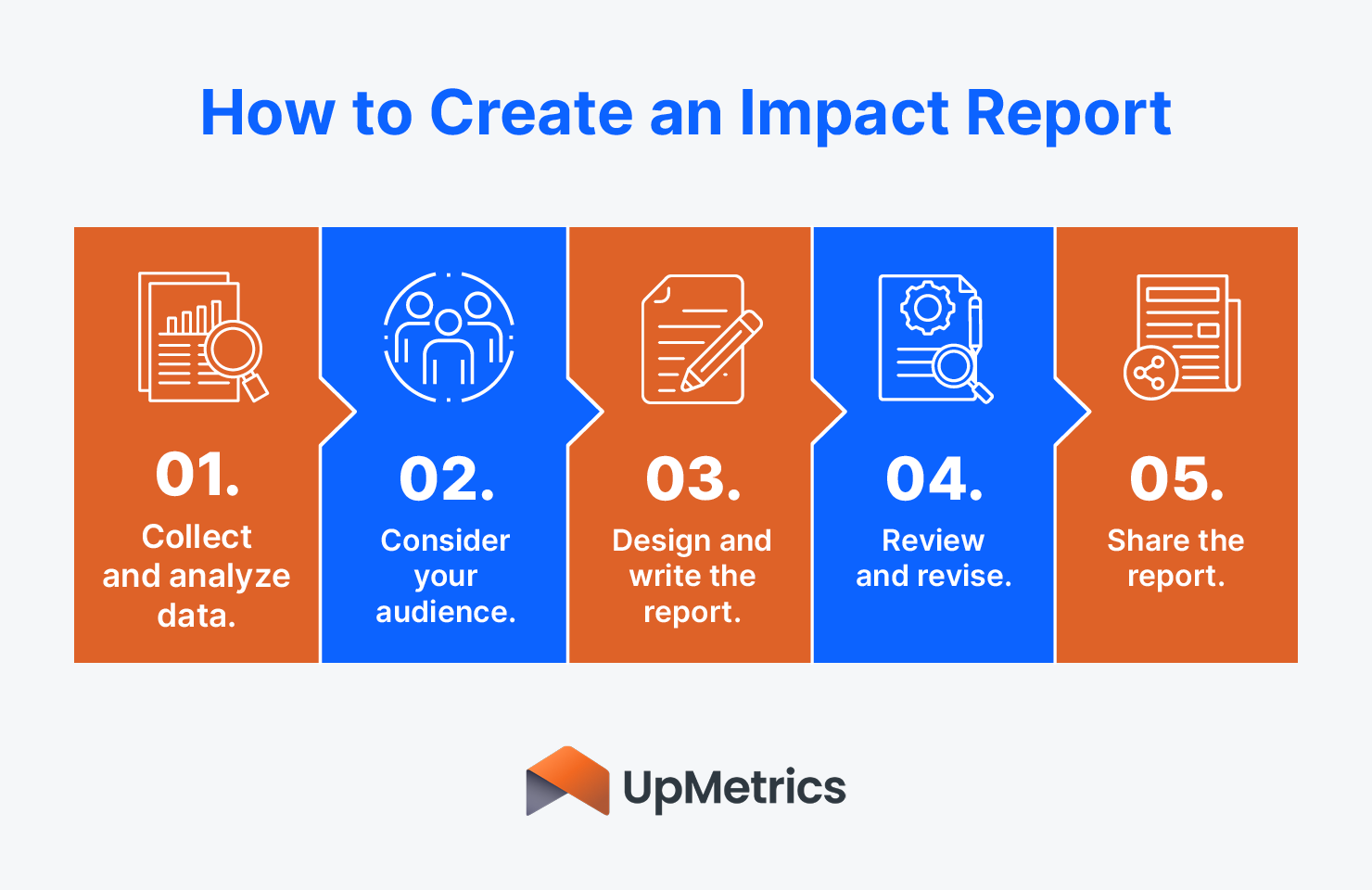
1. Collect and analyze data.
Without a solid base of verified evidence, even the most visually stunning report will lack the substance needed to drive stakeholder trust and secure future investment. Kick off your progress by building a data-driven foundation for your impact report.
First, determine the most relevant indicators to focus on. These should be both qualitative (e.g., testimonials) and quantitative (e.g., program outputs) indicators that highlight how your program impacted your community.
Once you’ve set these indicators, focus on centralizing that information from various donor databases, marketing tools, and field surveys. To achieve this, integrate your disparate software solutions and standardize your data points. The end goal is ensuring every data point is clean, categorized, and ready to be reflected in your impact report—that way, you’ll be able to best this program or initiative’s story.
2. Consider your audience.
Here is where you enter the Leverage stage of the DeCAL methodology. In other words, it's time to start building your impact report.
Begin by reviewing what you know about the audience you want to share your impact report with. Here are a few tips for doing so:
- Review existing data. Go back to your organization's database and review the information you've collected about your audience over the years. Identify your audience's key demographics, interests, and communication preferences. Look at any feedback your community has provided you over the years that may inform how you create or share your impact report.
- Segment your audience. To fully engage different parts of your audience, you may find it useful to segment them into groups based on shared characteristics. For example, you could create donor, volunteer, and corporate partner segments. Or you might create segments based on giving level. This way, you can create different versions of your report that speak to each segment's unique needs and preferences.
- Consider your communication channels. On top of thinking about your audience, determine which communication channels you'll use to share your report. Use any data you've collected about your marketing efforts to identify which channels are most successful for reaching your audience and build your report around them. For instance, if you know most of your audience prefers direct mail, you may want to design an impact report brochure you can send out.
Additionally, you may want to create an audience persona, which is essentially a fictitious person who represents your audience's typical traits. This way, as you design and write your report, you'll have a person to keep in mind who can guide the creation process and help you create a finished product that will truly resonate with your audience.
3. Design and write the report.
Using what you know about your audience, determine what you want your finished report to look like. In other words, decide what "genre" you'll be working within to create your report. There are several options, like:
- Traditional written report
- Infographic or visual report
- Interactive digital report
- Interactive web page or microsite
- Social media campaign
- Video report
You may also plan to include impact information in another report that you already produce on a regular basis, like your annual report. In this case, consider how your impact information can be woven into the usual details included in that report.
Once you know what form your report will take, consider what information you want to include from your impact measurement and management work. Not all of it will be relevant to your audience, so knowing how to pick and choose the most useful insights will be essential.
Also, brainstorm any visuals you may want to include in your report, whether they’re data visualizations from your impact management platform or pictures of your team at work.
With those aspects in mind, it's time to create a compelling draft of your report. As you do so, remember to:
- Start with a strong introduction that clearly explains your organization's mission and vision.
- Prioritize transparency by briefly explaining the methodology you used for measuring your organization's progress toward its goals.
- Be clear and concise, avoiding technical terms or organizational jargon that may confuse readers.
- Use specific examples and other details that bring your main points to life for your readers.
- Include testimonials and quotes from beneficiaries, volunteers, staff members, and other individuals involved in your work.
- End with a call to action that inspires more support.
4. Review and revise.
Once you've drafted your report, it's time to refine it for your audience. This will require you to step into their shoes and consider what they need from your organization in order to understand the positive effects of your work and be inspired to continue supporting you.
Start by reviewing the report internally. Then, you may want to ask a trusted stakeholder to review your draft and provide any feedback to strengthen it before sharing publicly.
As you put the finishing touches on the report throughout this process, ask yourself the following questions:
- Does the report effectively communicate our organization's mission, vision, and values?
- Does the report reflect our organization's most important achievements and high-priority needs?
- Is all of the information reflected in the report accurate and up-to-date?
- Have we effectively shared the necessary context to understand the report's findings?
- Is there a strong narrative flow in the report that helps to share our story in a compelling way?
- Are the visuals used in the report clear, relevant, and engaging?
- Is there a healthy balance between visuals and text in the report?
- Is the language in the report clear, concise, and simple?
- Is the structure of the report logical and easy to follow?
While it will be tempting to get your report out to your community quickly, taking the time to revise it will ensure that the report supports your larger goals and connects with your audience.
5. Share the report.
At last, it's time to publish your impact report through the communication channels your audience prefers.
As you do, provide context as to why you're sharing this information now. For instance, you may be wrapping up a successful year of programming or getting ready to launch a new fundraising campaign. And don't forget to encourage your audience to stay involved in your work!
Best Practices for Creating an Exceptional Impact Report
How you communicate your organization's impact matters, especially when it comes to encouraging community involvement. To make your impact report the best it can be, keep these tips in mind:
- Lean into storytelling. Stories made up of compelling characters, interesting conflicts, and satisfying resolutions are always engaging. Find a way to tell a story that positions your organization and its community as the key to resolving a large issue.
- Use both quantitative and qualitative data. It may be tempting to focus on the numerical values that help quantify the positive change your organization is spurring for its beneficiaries. But qualitative data also plays an important role in telling your full impact story. Pair your quantitative insights with qualitative descriptions, experiences, and testimonials. This will help bring your data to life!
- Be transparent about your methodology. Remember, one of the benefits of impact reporting is strengthening trust between your organization and its community, and transparency is key to achieving this benefit. Let your audience know where you got your impact data from, how you analyzed it, and the tools you used. Also, be clear that if anyone has questions about your insights, they're free to contact your organization.
- Focus on the good and the not-so-good. Your organization isn't perfect; it's normal not to reach every single one of your goals every time. While you'll want to celebrate all the good you've done in your impact report, don't shy away from reporting on things that didn't go as planned. Follow up with a clear statement of what you'll do the next time around to improve.
- Use visuals effectively. The right visuals can break up the text in your impact report and provide a different way of understanding the insights you want to share with your audience. Be discerning in how you select and position the visuals in your report, and take into account the visual look of your finished product before publishing it.
- Focus on what you're going to do next. An impact report is a sort of celebration of what your organization has accomplished so far in a specific period of time. Use your insights as a springboard to talk about what's in store for your organization's future, and invite your audience to get involved!
- Use an impact reporting platform like UpMetrics. Using a purpose-built software solution is the best way to achieve results faster. UpMetrics is the ultimate impact reporting tool for impact funders and nonprofits alike to visualize their progress—more on that later!
Hover over the different elements in the following example of an impact report to see these tips in action:
Examples of Great Impact Reports
Jane Addams Resource Corporation (JARC)
JARC is a nonprofit that teaches low-income adults and workers the essential skills they need to earn a living wage and overcome poverty.
This organization created an engaging impact report visual that included key information from their UpMetrics dashboard:
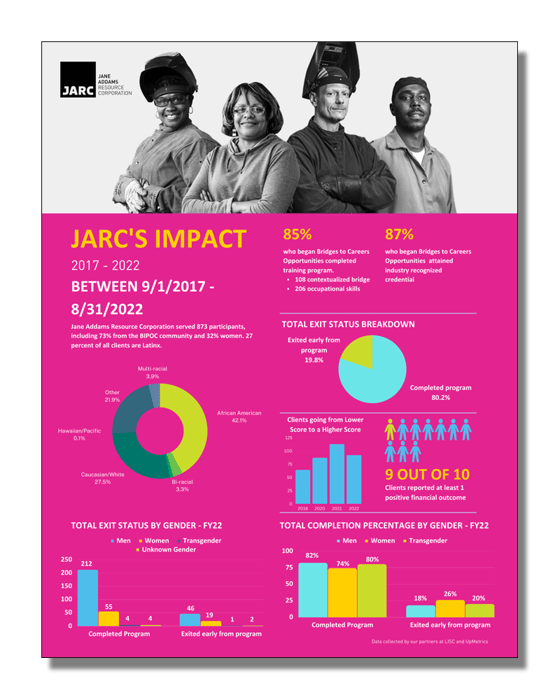
This simple, one-page visual succinctly shares JARC's most compelling impact information, like participant demographics, program completion percentage, and participants' reported financial outcomes.
Mentor California
Focused on growing quality youth mentoring relationships in California, Mentor California used the insights generated with UpMetrics' platform in its most recent "State of MENTORing in CA" report:

This is an example of a more thorough annual impact report document, which includes a foreword from the organization's executive director, an introduction to the organization, an explanation of the methodology used for organizational evaluation, and specific insights. The report is filled with engaging visuals that break up the text, and it also highlights survey and listening session responses from participants.
National Federation of State High School Associations (NFHS)
NFHS is an organization that writes the rules for most high school sports and activities and advocates for athletes and fine and performing arts participants.
Concerning their arts advocacy work, NFHS simply links to its UpMetrics dashboards on its website to showcase its impact:
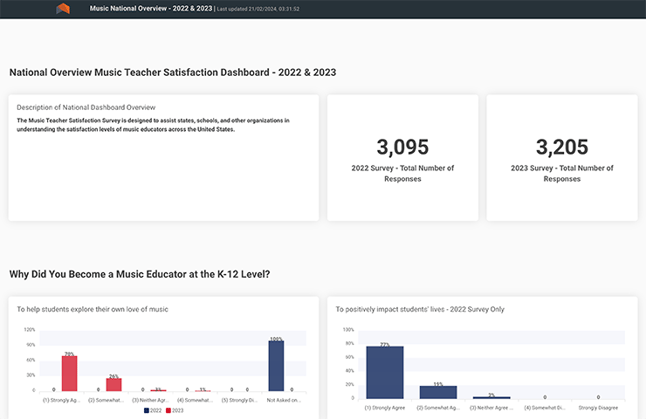
This is a less formal (but no less effective) form of impact reporting, as it allows stakeholders access to all the impact information available, which ensures transparency between the organization and its community.
UpMetrics: Your Partner in Impact Reporting
Reporting on your organization's impact can be a daunting task, especially if you're new to impact measurement and management or if your organization is working with limited resources.
This is why many organizations choose to streamline the process by partnering with an impact reporting platform provider like UpMetrics.
UpMetrics offers both easy-to-use tools and expertise from a team of social sector professionals to help you:
- Identify what you want to measure and report on.
- Gather and analyze data.
- Visualize your insights in customizable dashboards.
With our platform, you'll have the information and visuals you need to build an exemplary impact report and boost your capacity.
Wrapping Up
An impact report is an important asset for your organization, whether you're serving beneficiaries, funding nonprofits, or engaging your employees in CSR.
Follow the steps above to create an impact report that stands out, communicates your achievements and priorities, and shares your needs and future goals with supporters. As you do so, you'll experience more support and strengthened relationships with those who help to fuel your mission.
Want to keep reading? Check out these recommended resources about impact measurement and reporting:
- How to Measure Social Impact Like a Pro: A Full Guide
- Social Return on Investment (SROI): Measure the Intangible
- Participatory Grantmaking Principles, Potential, and More