Grant Reporting: Moving from Compliance to Strategic Impact
Most nonprofit leaders treat grant reporting like a high-stakes, one-time formality designed to satisfy a funder’s checklist. This approach turns reporting into a major time drain and traps your team in a cycle of looking backward. Taking a more dynamic approach to grant reporting enables you to learn from the past and invest more intelligently in your future.
Instead of letting data sit in a finished report, use it to tell a continuous story of impact. Creating a compelling impact story requires you to focus on data recyclability. This ensures every metric you capture for a funder also fuels your board governance, program learning, and donor marketing. This shift changes reporting from a burden into a competitive advantage.
In this guide, we’ll explore how to align your internal reporting with what big foundations actually want to see. As a result, you can stop being a grantee waiting for approval and become a true partner driving systemic change.
We’ll cover:
- Grant reporting FAQs
- How to write a grant report for a nonprofit
- What funders look for in impact reports
- Move beyond compliance with UpMetrics
Grant reporting FAQs
What is grant reporting?
Grant reporting is the process of telling funders how your organization used their grant money. It allows your organization to fulfill its funding obligations by demonstrating compliance with agreements. This process also enables you to demonstrate your organization’s impact and commitment to your mission, fostering transparency and accountability and making it easier to secure additional grant funds in the future.
What is the most important part of a grant report?
The most critical element of a grant report is the connection between your activities and your outcomes. Funders want to see that you used their money to achieve the specific goal outlined in the grant agreement.
How often should I update my grant reporting data?
Most funders require annual reports, but you should track your data in real time. Monthly or quarterly internal reviews allow you to catch program issues early. This ensures that when the deadline arrives, you aren't scrambling to find information.
What are vanity metrics in grant reporting?
Vanity metrics are numbers that look impressive but don't prove impact. While these are easy to track, they don’t tell you anything about why community members are engaging with your organization. Focus instead on more tangible metrics, such as increases in graduation rates or reductions in service wait times.
How to write a grant report for a nonprofit
To write an effective grant report, you must demonstrate what changed as a result of your program and the organization’s funding. Write a report that secures future funding by:
- Prioritizing outcome over output. Do not just list how many people attended a workshop. Explain how their lives changed because they were there. For instance, instead of reporting that 50 students participated in your program (the output), focus on the outcome: 90% of those students successfully secured academic scholarships as a direct result of the skills they learned.
- Establishing real-time tracking. Don’t wait until the grant cycle ends to gather your numbers. Tracking progress in real time prevents last-minute rushing and lets you catch errors early. To do this, you’ll need a purpose-built impact reporting platform—more on that later.
- Connecting data to narrative. Use specific stories to bring your statistics to life. If your data shows you served 500 students, include a brief case study of one student’s growth. This builds funder trust and helps them understand the emotional value of your work.
- Designing for readability. Program officers are often overwhelmed by a flood of data that lacks clear trends or meaningful context. Use clear headings and bullet points to make your report easy to scan and understand. This positions your nonprofit as a professional, thoughtful partner.
- Auditing for data recyclability. Ensure the information you collect isn't just for the funder. Use these same metrics to inform your board, fuel your social media marketing, and create impact reports.
Use this checklist to help stay on track with your grant report:
Ultimately, design your report to anticipate and answer the program officer’s next question regarding your scalability, sustainability, and cross-sector relevance. This proactive approach shows grant funders that your organization cares about building a positive relationship and using their funding wisely.
How to automate grant reporting
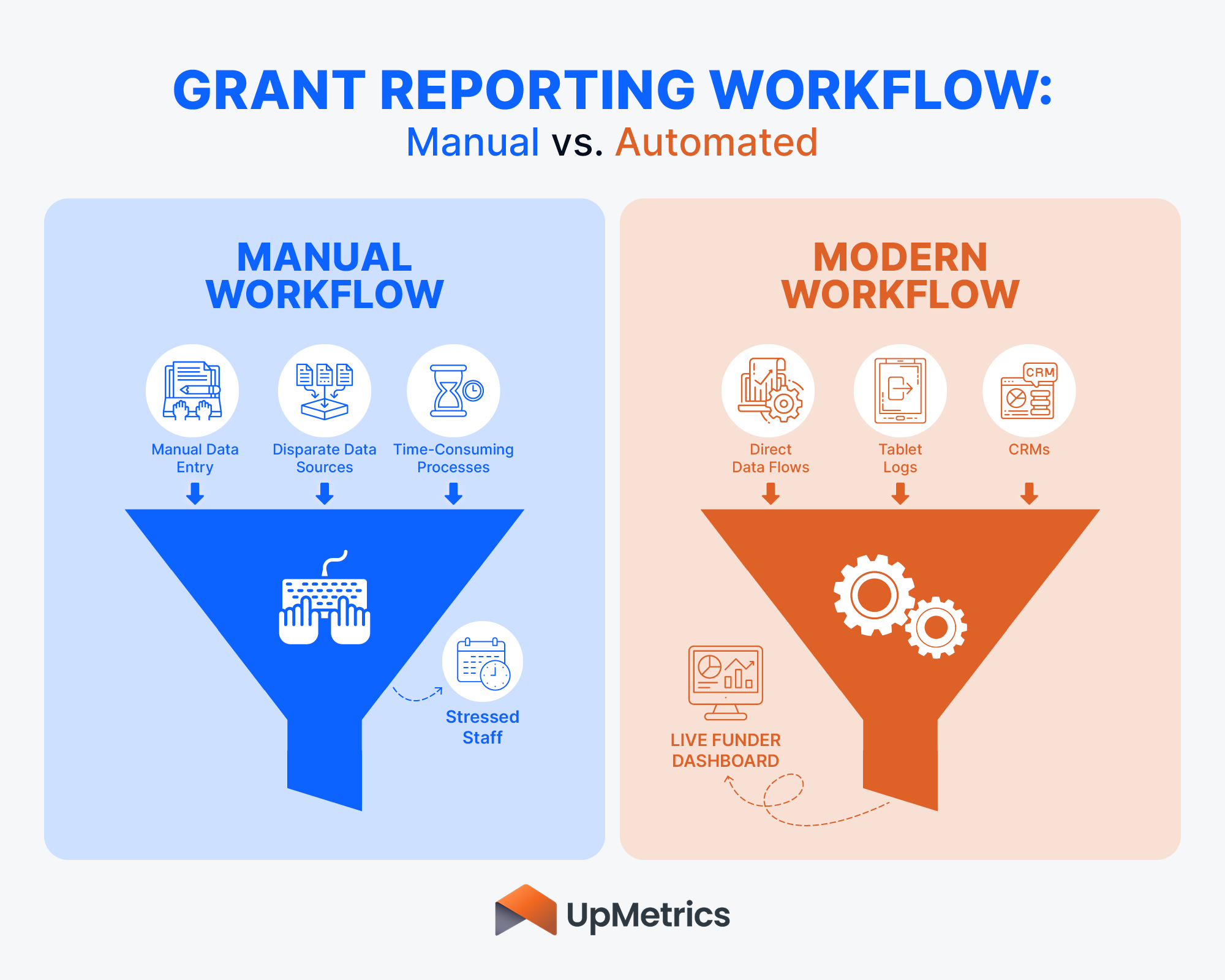
Manual data entry is a significant drain on nonprofit efficiency. Most fundraising teams waste hundreds of hours every year moving numbers between paper forms, spreadsheets, and PDFs. Automation allows you to turn messy manual workflows into modern, streamlined processes:
Follow these steps to get started with grant automation:
- Create a real-time data repository: Establish a system that routes field data directly to a live dashboard. This structure allows your organization to avoid frantic, last-minute efforts to gather and compile grant report data. For example, instead of having your program manager spend time manually tallying sign-in sheets for a recent community workshop, you can use an automated system that logs attendance via a tablet and updates the funder's dashboard instantly.
- Bridge the AI education gap: Automation relies on staff having the right skills. A survey of over 4,000 nonprofits using the Google for Nonprofits program found that 40% of organizations have no staff with AI or automation training. Closing this skill gap is essential for mitigating AI risk and using the tools to their fullest potential. Start small by polling staff on their AI knowledge and skills; based on the results, put together a training plan that covers the most common gaps and addresses pertinent use cases.
- Standardize metrics across the organization: Automation thrives on consistency. To effectively automate reporting, ensure that all programs are tracking data using the same definitions and units of measurement. By creating a unified data dictionary, you eliminate the need for manual data cleaning when it’s time to compile a grant report.
- Integrate your existing tech stack: Your grant reporting shouldn't exist in a vacuum. Most nonprofit automation efforts fail because data is siloed in separate tools for donor management, project tracking, and finance. Use integrations to ensure that when a donation is logged or a program milestone is reached, your impact reporting platform receives it and assigns it to the correct program.
In addition to turning grant reporting into a proactive process, automation acts as a self-operating, centralized system that makes your organization permanently audit-ready. By continuously verifying data flows and eliminating manual transcription, you can create a detailed audit trail that protects institutional knowledge and ensures it’s immediately accessible to leadership.
What funders look for in grant reports
Trust is the primary currency in the modern philanthropic landscape. Funders are moving away from rigid, restricted grants to flexible, long-term partnerships. To secure these high-trust grants, you must demonstrate:
- Evidence of internal infrastructure: According to the Center for Effective Philanthropy, more foundations are prioritizing multi-year general operating support (GOS), which is unrestricted funding to cover operating expenses like rent and salaries, rather than specific charitable projects. They want to see that your organization has the systems to learn from its own data and iterate from past experiences.
- Radical transparency: Foundations value honesty about program failures. Admitting when you miss a target and explaining your next steps builds trust and demonstrates your commitment to the cause. For example, if your workforce development program had a high dropout rate, explain that the cause was a lack of childcare. Then, show how you are partnering with a local daycare to correct this issue now, in addition to the long-term steps you’re taking to mitigate the problem going forward.
- Owning your story: When you control your own data, you control the conversation with funders. Instead of just reacting to their questions, you can show them exactly why your work is a smart investment. This builds professional respect and shifts the relationship from one in which you’re asking for help to one in which you're offering a partnership.
- Long-term efficacy: Moving from a first-time partner to a repeat collaborator requires demonstrating lasting change and impact. Prove that your intervention is solving a systemic problem by connecting your immediate program outputs to data that demonstrates a fundamental, sustainable shift in the community’s trajectory.
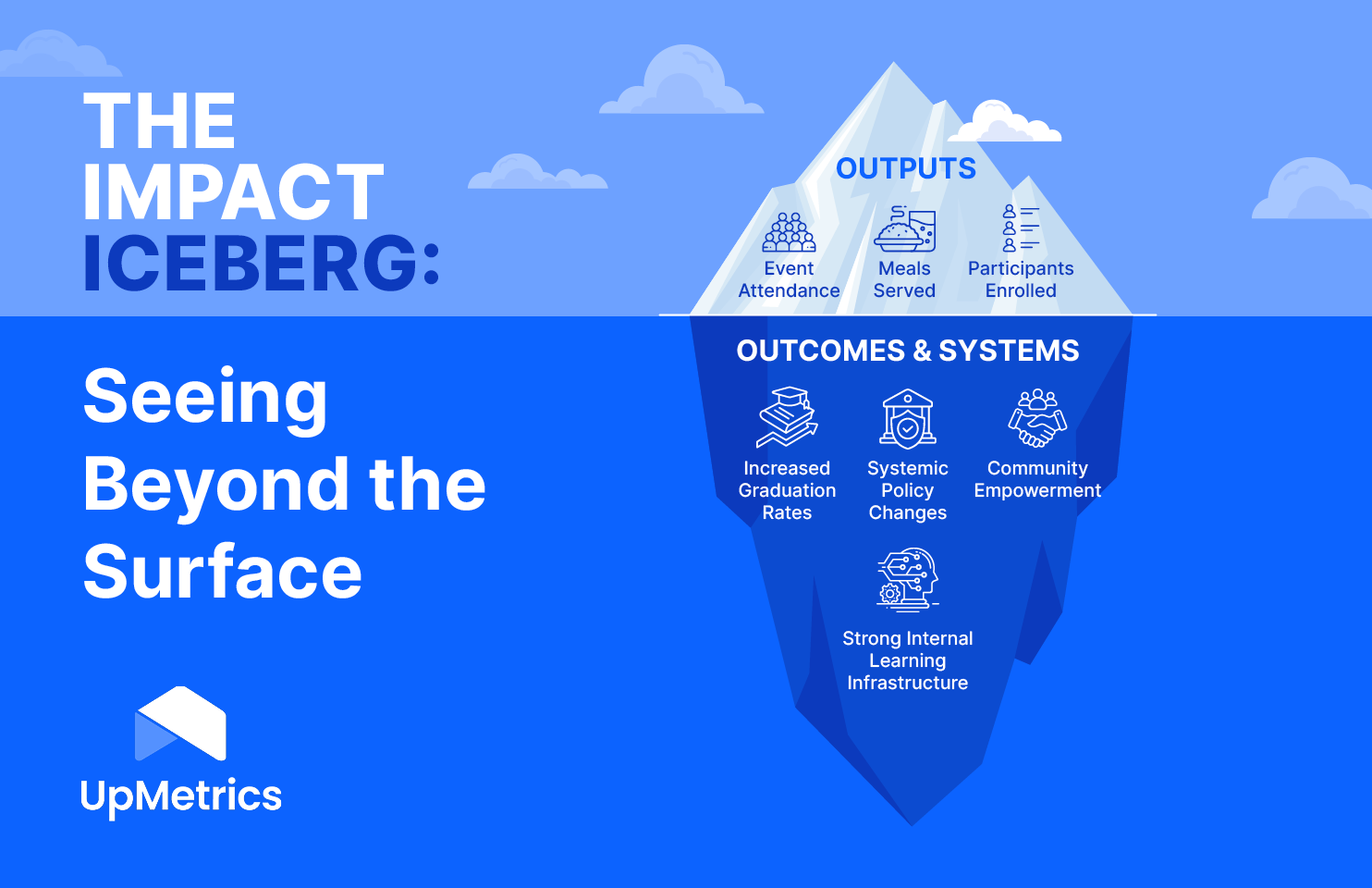
Take a look at your previous grant reports to identify the gaps. Where did you fall short of providing full transparency? Where did you not go far enough in describing the strength of your internal infrastructure?
Move beyond compliance to leading with impact with UpMetrics
Treating grant reporting as more than a checklist item requires shifting how you view your data. Most nonprofits struggle because their data is siloed. Finance has the spending logs, program managers have the attendance sheets, and development has the donor notes. This fragmentation makes it impossible to see the big picture.
UpMetrics’ impact reporting platform breaks these silos, turning raw data into a compelling narrative of change. Our centralized system creates a data flywheel where every data point you collect for a grant report is automatically added to your board dashboard, informing your next fundraising appeal. This is how you move from surviving the grant cycle to leading with impact.
Here is how UpMetrics specifically empowers your organization to make this shift:
- UpMetrics breaks down data silos by making it easy to import and centralize data from multiple systems, including pen-and-paper documents, into a single unified platform. You can also seamlessly gather new information with customizable data-capture and survey tools.
- Instead of tracking disconnected data points, you can design an impact framework that translates your organization's mission into specific key impact indicators (KIIs). This ensures everyone collects the right data across five key dimensions: who you serve, what you deliver, the quality of delivery, how beneficiaries are better off, and your community contribution.
- Once data is centralized, you can leverage compelling data visualizations and interactive dashboards to analyze your progress. This provides clear visibility into your programs, allowing you to understand what's working, uncover areas for improvement, and make informed decisions.
- Keep stakeholders and organizational leaders continually engaged by sharing read-only links to your dashboards or embedding visualizations directly into your website. This simplifies reporting and shares important data securely.
- By using the platform to track and measure outcomes, you can leverage your insights to tell a complete, compelling story of your impact. Backing your narrative with clear, credible data helps you effectively demonstrate your impact to grantmakers, making a stronger case for receiving or increasing funding.
Wrapping up
Effective grant reporting demonstrates that you have the internal infrastructure to advance your mission. Don't let your data sit idle in a PDF. Use it to prove your worth, secure more support, and grow your mission. When you align your internal reporting with what funders actually want to see, you prove why your work is essential, build long-term partnerships, and power your progress.
Additional Resources
- 15 Leading Impact Frameworks and How to Pick (or Build!) One.
- Qualitative Measurement in Driving Social Good: A Guide.
- What Is Impact Measurement? Here’s A Complete Rundown.