15 Leading Impact Frameworks and How to Pick (or Build!) One
Imagine you're headed on a road trip. You know you're heading in the right direction, but you don't have a map or GPS. You'll likely get to where you want to go eventually, but it will be a lot harder without a way to track your progress or avoid detours.
In the world of impact reporting, an Impact Framework is like your map or GPS. It provides clarity, structure, and direction as your organization (or an organization you fund or support) works toward its impact goals and communicates with its audience.
In this guide, we'll cover everything you need to know about Impact Frameworks, including:
- FAQs About Impact Frameworks
- 15 Impact Frameworks to Consider Using
- How to Select and Leverage Your Own Impact Framework
FAQs About Impact Frameworks
What is an Impact Framework?
An Impact Framework, also known as an Impact Measurement Framework, is a strategic resource used by impact producers and impact funders to define how their organizations will measure, manage, and communicate impact.
These tools help organizations evaluate progress toward impact goals, ensure that grantmaking or program delivery strategies align with the organization's larger mission and deliver measurable impact, and track long-term outcomes of various aspects of their operations.
The ultimate goal of creating and using an Impact Framework is to help an organization apply a critical eye to its impact sizing efforts so that it can do more for the causes and communities it cares about, whether that means fighting climate change or improving access to healthcare.
Plus, because a Framework provides a simple, standardized way of telling an organization's impact story, it creates a common language that facilitates collaboration and learning between impact funders, impact producers, and their communities.
What a Framework Empowers You To Do
Leveraging an Impact Framework can provide your organization with many benefits. Specifically, these tools empower you to:
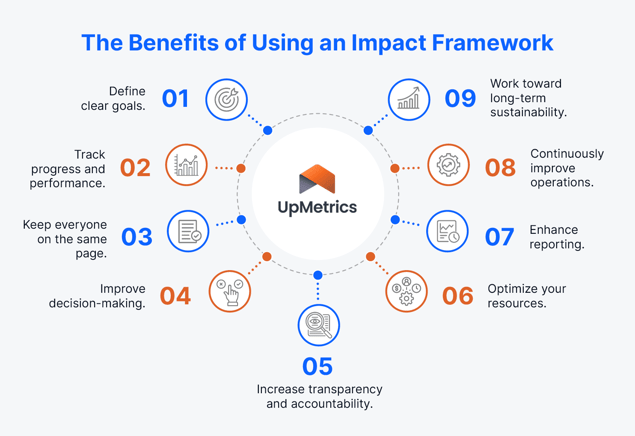
- Define clear goals. Set goals across different focus areas that will help you maximize your impact and get closer to accomplishing your organization's broader mission and vision.
- Track progress and performance. Use the structure of the Impact Framework to monitor and evaluate the effectiveness of different strategies, projects, programs, and initiatives over time.
- Ensure all stakeholders are on the same page. Keep everyone in your organization's community—from funders to beneficiaries—aligned on your impact goals and priorities.
- Improve decision-making. Gather data that provides insights into what is working and what needs improvement, and use this information to make strategic adjustments and drive better results for your organization and its community.
- Increase transparency and accountability. Build trust with those who support or benefit from your work by clearly communicating how resources are being used and what results are being achieved.
- Optimize your resources. Identify which activities or strategies are delivering the most value so you can make the most of your funding and your team's time.
- Enhance reporting. Streamline and improve the impact reporting process by accessing up-to-date and well-organized information about your impact.
- Continuously improve your operations. Develop a culture of reflection and learning at your organization that allows your team to continuously refine its approach and drive greater impact.
- Work toward long-term sustainability. Over time, create more sustainable and scalable strategies that drive long-term impact for the causes you care about.
In short, if you want to get a fuller picture of your organization's progress toward its impact goals, be able to communicate that progress, and make improvements to your approach to driving impact, an Impact Framework is a must.
What are the core components of an Impact Framework?
There are many Impact Frameworks to choose from, and they can vary greatly. But there are a few key components that effective frameworks commonly include:
- Impact goals: Identify the change you’re trying to create across different focus areas.
- Progress indicators: At UpMetrics, we refer to key progress indicators or key performance indicators as key impact indicators (KIIs). These are specific metrics you track over time to assess your progress toward your objectives.
- Data collection processes: Establish methods for gathering data, such as interviews with beneficiaries or measuring specific outputs related to your work. Also, define how frequently you’ll collect this data.
- Data analysis: Analyze your data to understand your results and identify any patterns present in your collection. Avoid making assumptions where there’s no proof of causality, and address any unintentional or negative outputs you may discover.
- Reporting method: Decide how you’ll share your findings with stakeholders, which includes anyone impacted by your work or involved in your organization’s community.
15 Types of Impact Frameworks to Consider Using
Generally speaking, creating your own Impact Framework involves setting specific impact goals aligned with your organization's mission and selecting relevant metrics to measure progress toward those goals. From there, you can dive into the rest of the impact reporting process.
However, many organizations find it useful to leverage an existing Impact Framework, as it provides a proven structure and process for impact reporting that can save your organization time and resources. Plus, it helps standardize your impact reporting, so you can compare your efforts to those of other organizations.
These frameworks are often designed by experts, meaning your organization can be confident that they’re comprehensive and aligned with best practices for measuring and managing impact. There are several options to choose from, so we’ve outlined the top picks your organization might consider using for its impact reporting process.
1. Our Top Recommendation: UpMetrics' Impact Framework
At UpMetrics, we've created our own Impact Framework that is easy for any organization to leverage and powerful enough to help you gather critically important insights and make educated decisions about elevating your impact.
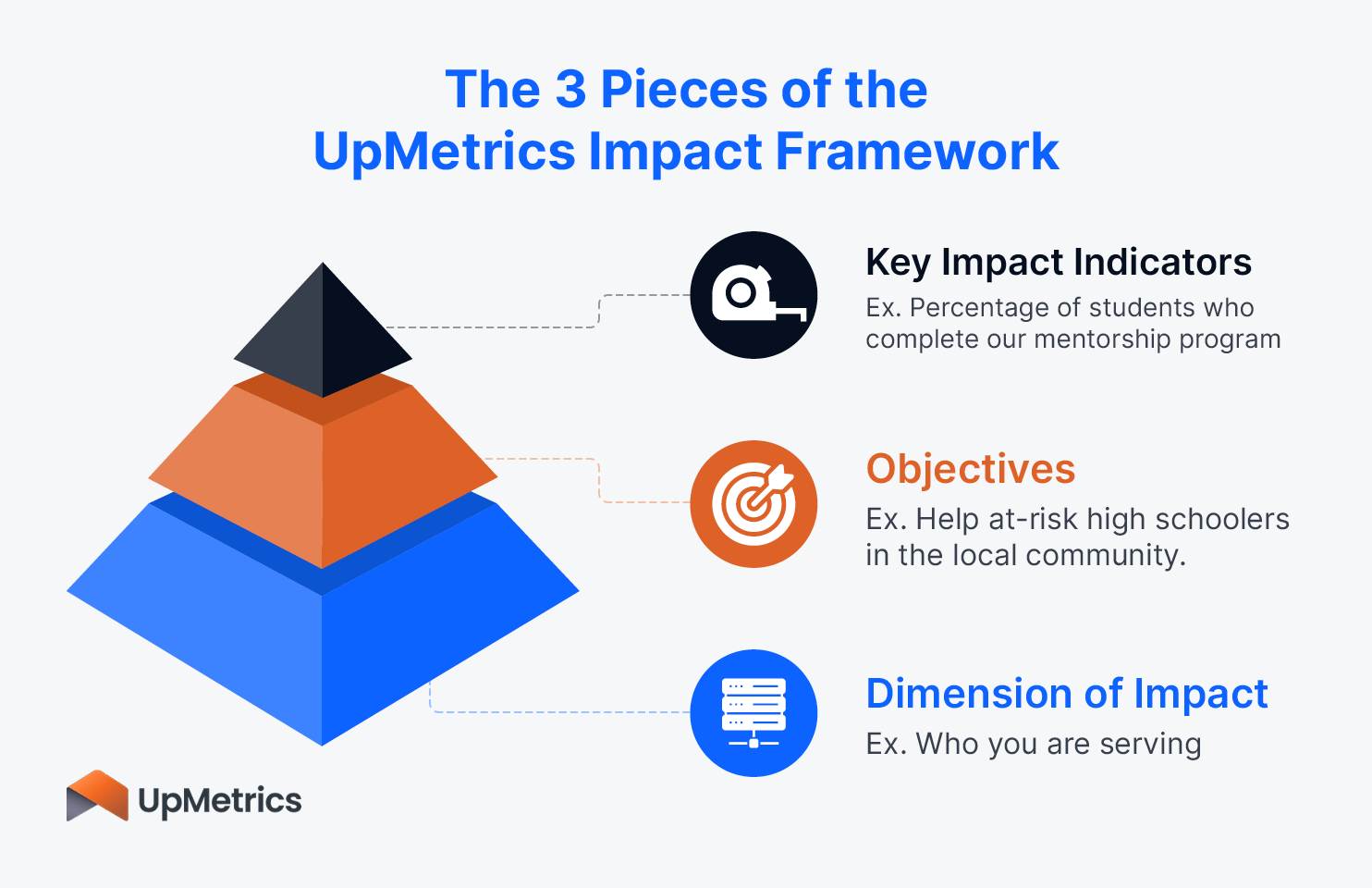
There are three key pieces to our Impact Framework model:
Piece #1: Dimensions of Impact
Dimensions of impact are the various aspects or categories your organization can use to think about and assess its impact. Our Impact Framework encourages you to consider your organization's mission and vision within these specific dimensions of impact:
- Who you are serving
- What you are delivering or doing for those you serve
- The quality of that service delivery
- How those you serve are better off because of what you deliver
- Community contributions, or the larger (perhaps indirect) effects your efforts have on your organization's broader community
Within these dimensions of impact, you'll define specific impact objectives and corresponding key impact indicators that help you measure your progress in these areas.
Piece #2: Objectives
Objectives allow you to determine what you want to achieve within different dimensions of impact, the smaller goals that will get you closer to accomplishing your larger mission.
Here are some examples of objectives you might create:
- Lower carbon emissions across the county.
- Serve at-risk youth in the local community.
- Deliver a high-quality maternal nutrition education program.
- Foster ethical business practices.
- Reduce gender-based disparities in employment.
While objectives can be project-based, they can also be broader goals your organization has for itself. Include a healthy mix of different types of objectives in your Impact Framework to measure your progress both at a high level and in more specific ways.
Piece #3: Key Impact Indicators
At UpMetrics, we refer to key progress indicators or key performance indicators as key impact indicators (KIIs). These are specific metrics you track over time to assess your progress toward your objectives.
Here are some examples of KIIs that correspond with the objectives listed above:
- Total metric tons of CO2 emissions reduced annually through community-wide sustainability initiatives
- Percentage of youth who complete our mentorship program
- Satisfaction scores from nutrition education program participants
- Number of businesses that commit to following agreed-upon ethical standards
- Percentage increase in the number of women hired
Keep in mind that you can select several KIIs for each of your objectives. After all, there will likely be several different ways you approach your objectives, and you'll want to measure the progress you see in those different areas. For example, for the "Reduce gender-based disparities in employment" objective above, you might track the percentage increase in number of women hired and the number of women who secured promotions.
The UpMetrics Impact Framework Template
All the pieces above are nested underneath each other in a complete UpMetrics Impact Framework. Here is a visual to demonstrate how this works:
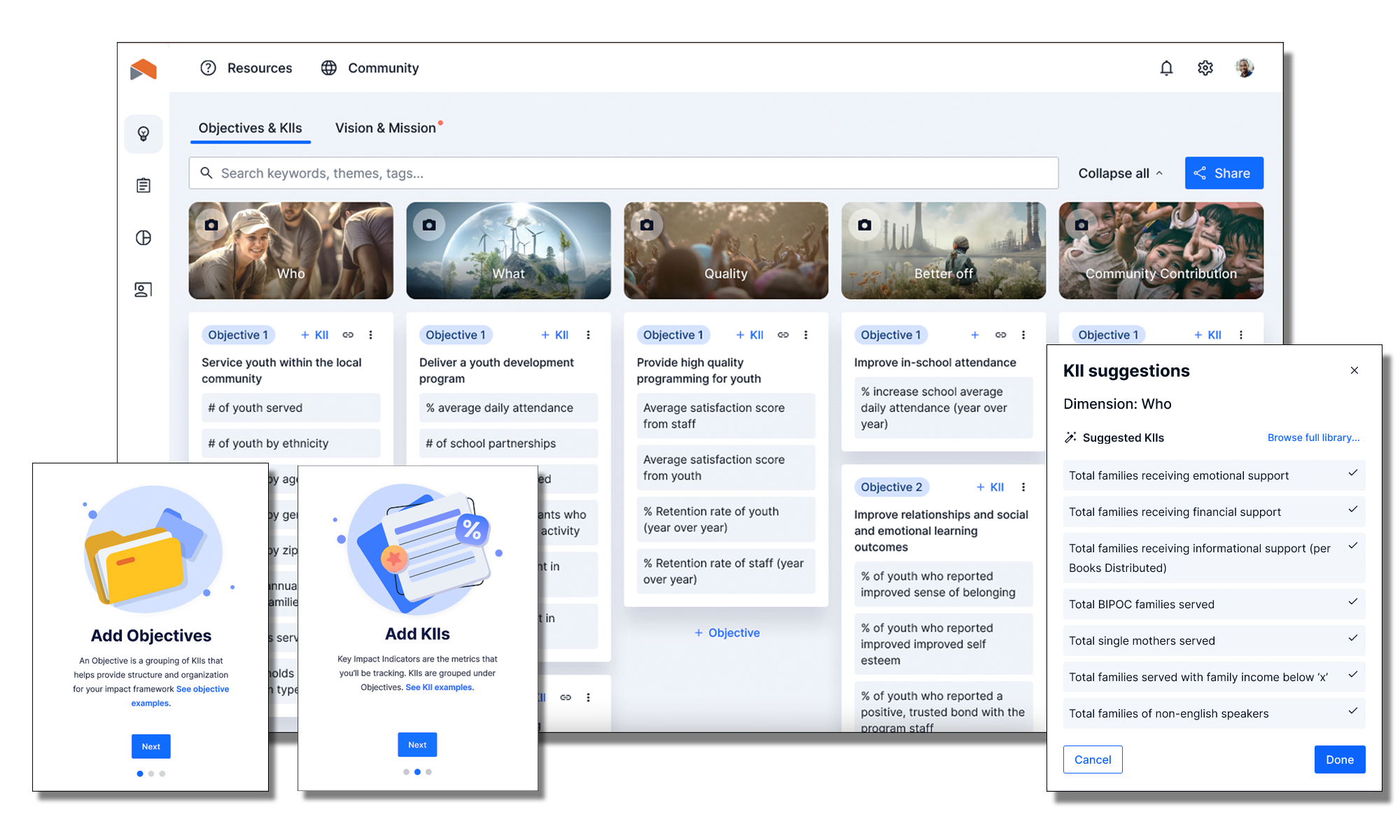
To easily create your own customized Impact Framework through a guided process, consider using the UpMetrics IMM platform. Here is an example of what a typical Impact Framework looks like in our tool:
2. Theory of Change
A theory of change (ToC) Impact Framework helps an organization plan out the activities or interventions it needs to enact to reach a specific goal.
To implement this Framework, you would go through the following process:
- Identify long-term goals.
- Backwards-map the preconditions or requirements needed to achieve your goals.
- Identify basic assumptions about the context you're working within.
- Determine the interventions your initiative will put into play to create the change you wish to see.
- Select indicators to measure your outcomes and assess your initiative's performance.
- Write a narrative to explain the logic of your initiative.
3. Logic Model
A logic model is a visual representation (like a table or diagram) that shows how an activity or intervention will help an organization achieve a specific goal. It's similar to a ToC in that you'll identify:
- Resources you need for your work
- Activities that will drive your impact
- Outputs you'll measure to understand your impact
- Outcomes you hope to see over time as a result of your work
- The impact or key change your work is helping your organization move toward
However, unlike a ToC, a logic model doesn't explain the why behind impact. It's more of a descriptive tool that outlines what is expected to happen. Consider what information you're trying to gather if you find yourself choosing between a ToC and a logic model.
4. Social Return on Investment
Social Return on Investment (SROI) allows your organization to assign monetary values to specific projects or programs. You can then evaluate the social, economic, or environmental value generated by those projects or programs.
If you choose to embrace SROI as your organization's Impact Framework, keep these seven principles in mind when calculating the value of your projects or programs:
- Involve stakeholders. Any individual or group impacted by a program or project should factor into your calculations.
- Understand change. Determine how change has occurred through the program or project.
- Value the most important things. Assign monetary values to generated outcomes.
- Include material outcomes. SROI calculations should only include what is material and tangible.
- Avoid exaggerations. Commit to honesty early on in the calculation process.
- Be transparent. Transparency should apply in all aspects of the accounting process, including tracking, communication, state goals, prioritized metrics, data collection, and campaign analysis.
- Results verification. Results should be verified externally to ensure credibility.
Want to learn more about this Framework?
5. Impact Reporting and Investment Standards
Developed in part by the Global Impact Investing Network (GIIN), the Impact Reporting and Investment Standards (IRIS) are the generally accepted performance metrics that many impact investors use to measure, manage, and maximize their impact. These standards are updated regularly according to market evolution, but to get a better idea of the IRIS approach, you can explore a catalog of key metrics that are used within this Framework to evaluate impact.
The GIIN offers its IRIS+ system as a free, publicly available resource to empower investors to make great investment decisions and drive more positive impacts for social and environmental causes.
6. Systems Mapping
According to the World Resources Institute, a systems map is a visual depiction of a system of organizational operations, including all of its relationships, feedback loops, actors, and trends. Understanding the system your organization is operating within allows you to see how different elements influence one another and contribute to the overall function of the system.
Global nonprofit consulting firm FSG offers a Framework for different tools and ways of thinking about systems mapping, such as actor mapping, ecocycle mapping, and the World Cafe method.
7. B Impact Assessment
If your organization is a business, you may be interested in obtaining a B Corp Certification. This is a designation given by B Lab Global to businesses that:
- Demonstrate high social and environmental performance
- Make a legal commitment to changing their governance structure to be accountable to all stakeholders (not just shareholders)
- Exhibit transparency by allowing their performance against B Lab standards to be publicly available
The B Impact Assessment is a digital Impact Framework tool that helps businesses measure, manage, and improve their impact while working toward their B Corp Certification.
The Assessment requires businesses to answer a series of questions about its practices and outputs across five categories: governance, workers, community, the environment, and customers. You then compare your performance to other organizations that have completed the Assessment and make plans to improve over time.
8. Partnership Structures
If your organization often collaborates with other organizations, it can be helpful to have a structure for developing those partnerships so you can then evaluate how well they help you achieve your impact goals.
Resonance Global identifies a few common types of cross-sector partnerships:
- Joint project: A short-term collaboration on a single project
- Joint program: Small partnership formed around a single focus area that involves multiple projects or deliverables
- Multi-stakeholder initiative: Multiple partners and their resources align to drive change on a shared agenda (often requires a governance structure)
- Collective impact: Several partners commit to working on a common agenda for the long term
Though partnership structures aren't an Impact Framework per se, understanding the makeup of your current partnerships and being mindful about how you form future partnerships sets you up to make strategic decisions about what Impact Framework you'll use throughout your partnership to ensure you're creating the impact you want to create together.
9. Shared Value
A shared value Impact Framework encourages organizations to adopt strategies that simultaneously create value for themselves and drive long-term positive social or environmental change. According to the Australia-based Shared Value Project, "[An organization's] success and social progress are interdependent."
With this Framework, organizations measure and manage their impact in three key areas:
- Reconceiving products and markets: Creating new products and services or markets that are better for social good
- Redefining productivity in the value chain: Using resources efficiently and sustainably
- Building local clusters of support: Improving the local community and economy by creating partnerships and collaborations that benefit organizations and the communities they operate in
10. Sustainable Development Goals
The Sustainable Development Goals (SDGs) are 17 goals adopted by the United Nations (UN) in 2015 that aim to end poverty, protect the planet, and ensure peace and prosperity by 2030.
These goals are:
- End poverty.
- End hunger.
- Ensure well-being and healthy lives for all ages.
- Ensure quality education for all.
- Achieve gender equality.
- Ensure availability of water and sanitation for all.
- Ensure access to affordable and clean energy.
- Promote sustainable economic growth and decent work for all.
- Build resilient infrastructure, promote innovation, and achieve sustainable industrialization.
- Reduce inequality in and among countries.
- Make cities and communities safe and sustainable.
- Ensure sustainable consumption and production patterns.
- Take urgent action to combat climate change.
- Conserve and sustainably use the oceans.
- Conserve and sustainably use life on land.
- Promote peace and justice and create inclusive institutions.
- Strengthen the Global Partnership for Sustainable Development.
Organizations that want to contribute to the UN's efforts to accomplish the SDGs can build their IMM processes around these specific goals. To help, B Lab and the United Nations Global Compact have developed the SDG Action Manager, a tool that is designed to help businesses get involved and track their progress toward relevant SDGs.
11. Results-Based Financing
Results-based financing (RBF) is a funding strategy where funding is given based on measurable outcomes or results rather than being given upfront based on needs or inputs.
RBF helps funders align their funding choices with the outcomes they want to achieve, allowing them to encourage organizations that want their support to be extra innovative and efficient.
Similar to partnership structures, RBF isn't an Impact Framework itself. However, it can be used within an Impact Framework to help funders make decisions about what types of organizations or initiatives they want to support.
12. Balanced Scorecard
The Balanced Scorecard (BSC) methodology allows organizations to get a holistic (or balanced) view of their performance by looking at both financial and strategic measures.
This Framework recommends organizations examine their operations from four different perspectives to determine objectives, KPIs, targets, and initiatives:
- Financial: The organization's financial performance and use of resources
- Customer/stakeholder: The organization's performance from the perspective of customers or key stakeholders
- Internal process: The quality and efficiency of the organization related to its products or services
- Organizational capacity: The human capital, infrastructure, technology, and culture that are key to performance
The beauty of the BSC is that it allows organizations to draw connections between projects and programs, KPIs, strategic objectives, and the organization's larger mission, vision, and strategy.
13. Impact Management Norms
The Impact Management Norms were developed by a community of enterprises and investors led by the Impact Management Project. In 2021, the organization Impact Frontiers became the steward of the Norms.
There are five core building blocks that make up the Norms of this Impact Framework. The building blocks can quickly get complex, but here is a quick overview of each to give you an idea of how this Framework works:
- Five dimensions of impact
- What: The outcome the organization is contributing to
- Who: The people and communities experiencing the outcome
- How much: How many people experienced the outcome, the degree to which they experienced it, and for how long
- Contribution: Whether an organization's efforts resulted in outcomes better than what would have occurred otherwise
- Risk: The likelihood that impact will be different than expected
- ABC of Enterprise Impact: This system helps connect an organization's high-level intentions to more granular dimensions of impact and data. It's a classification tool that can be applied at the outcome, enterprise, and portfolio levels. The three main classifications are:
- A: Act to avoid harm
- B: Benefit people and the planet.
- C: Contribute to solutions.
- Investor contribution strategies: Investors typically describe four strategies by which they can contribute to impact. These are:
- Signal that impact matters.
- Engage actively.
- Grow new or capital markets.
- Provide flexibility on risk-adjusted financial return.
- Investment classification: Investors can use impact classifications to convey whether the impact characteristics of an investment opportunity match their intentions and constraints.
- Impact-financial integration: To help investors balance the need for financial returns and the desire to create impact, the Norms help investors integrate their financial management and impact management efforts.
14. Collective Impact
Collective impact is a Framework that brings organizations, community members, and institutions together to address social issues on a large scale.
Specifically, the collective impact Framework encourages communities to build their impact initiatives around five conditions:
- It starts with a common agenda. The community comes together to define the problem and create a vision to solve it.
- It establishes shared measurement. Tracking progress in the same way across the collective community allows for shared learning and accountability.
- It fosters mutually reinforcing activities. Community members should integrate many different activities to maximize the end result.
- It encourages continuous communications. Communities should prioritize building trust and strengthening relationships.
- It has a strong backbone. There should be a team dedicated to aligning and coordinating the community’s work.
This Impact Framework puts a large emphasis on equity, trust, and collaboration, so if you or your organization is interested in making a shift toward trust-based philanthropy, this may be a Framework you want to learn more about.
15. Human-Centered Design
Human-centered design (HCD) is a problem-solving approach that can be applied to any IMM effort.
Simply put, it prioritizes the needs, experiences, and perspectives of the people directly impacted by an initiative, program, or product. It helps ensure solutions are relevant and effective for the real people affected by an organization's work.
HCD centers on empathy, encouraging organizations to truly get to know their audience's needs, pain points, and desires before taking action. It also recognizes these things will shift over time, so organizations will need to continuously revisit its audience's needs and keep them at the heart of everything they do.
How to Select and Leverage Your Own Impact Framework
Every Impact Framework is a little different in its methodology, focus area, level of detail required, and flexibility. As you consider which Framework is the best fit for your needs and implement your chosen tool, keep the following tips in mind:
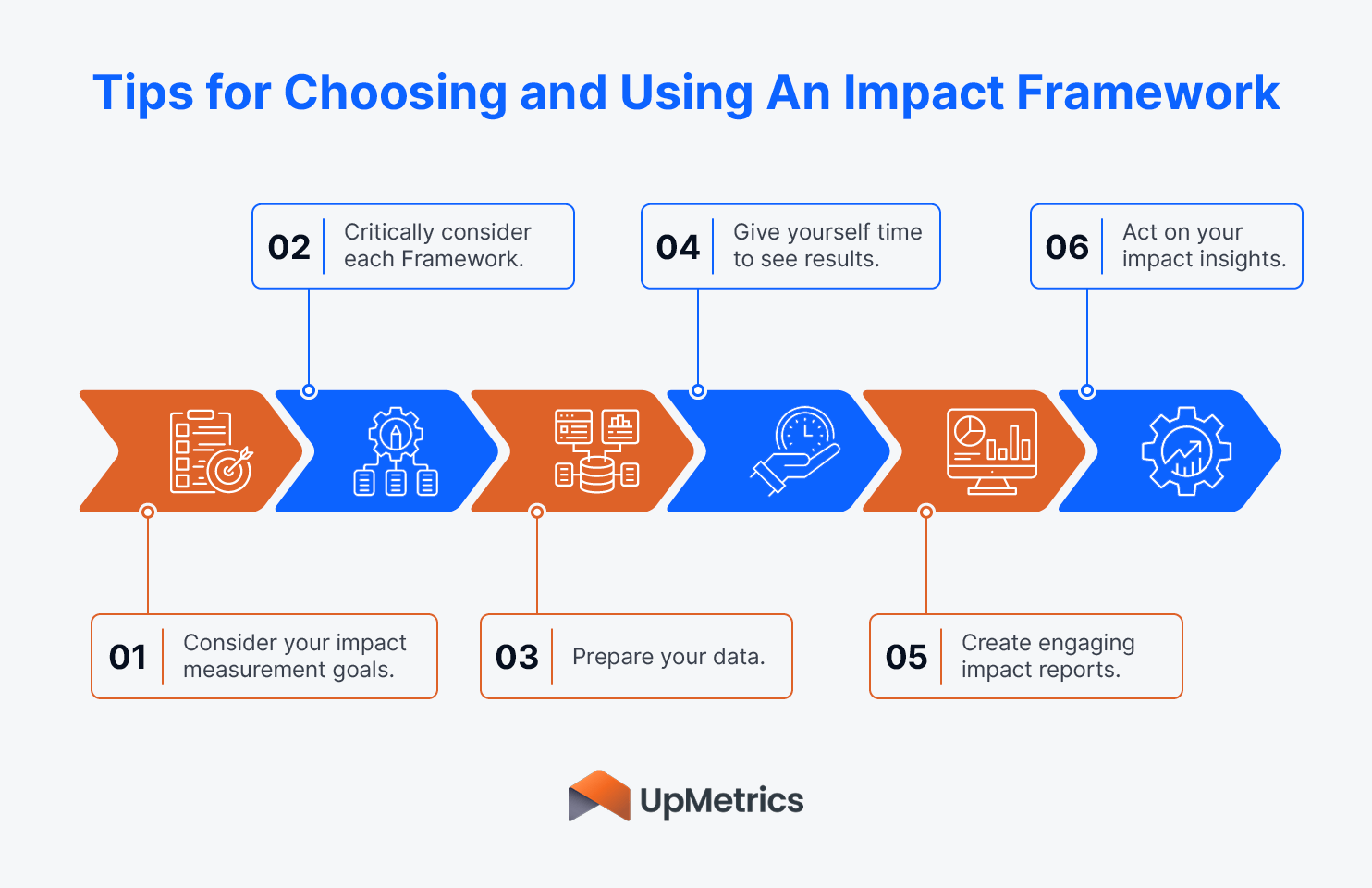
1. Think through your impact reporting goals.
Perhaps your organization is a nonprofit, and you want to demonstrate to grantmakers that it’s worthy of support. Or maybe you're an impact investor who wants to empower your portfolio companies to do more in their focus areas. Either way, think through your "why" for embracing impact reporting, and then revisit the Impact Frameworks that you feel will help you best reach your goals.
2. Critically consider each Framework.
When comparing each Framework, also consider:
- The Framework’s alignment with your mission and values
- The complexity of your operations, compared to what the Framework will help you track and evaluate
- What your specific stakeholders will want to know about your organization's impact
3. Prepare your data.
No matter which Framework you select, data will be a key player in your impact reporting efforts. Practice good data hygiene with your existing data to ensure the reporting process yields accurate insights. This typically involves:
- Reviewing your data to ensure everything is accurate and up to date.
- Removing unnecessary data that’s cluttering your database.
- Verifying information to ensure it’s still accurate and relevant.
- Standardizing data entry formats, such as using the % symbol instead of spelling out “percent.”
Additionally, evaluate the sources you'll turn to for further data collection. For example, you may reach out to certain stakeholders or access publicly available data, such as government agency reports and academic studies.
4. Give yourself time to see results.
Once you've implemented your chosen Impact Framework, give it some time before you try to draw insights from your impact reporting process. The key to a great report is tracking your progress over time and monitoring trends and patterns in your data, so patience is vital.
5. Create engaging impact reports.
Once you have impact insights to share, don't settle for a plain, written document. Find ways to create impact reports that are engaging and tell the story of your efforts to create positive social change. For instance, you can create a dynamic, interactive webpage with eye-catching infographics or film an impact report video that features real testimonials from beneficiaries. Use what you know about your stakeholders to design a report that will grab and keep their attention.
6. Act on your impact insights.
The end goal of impact reporting is to increase your positive impact. As you gather impact insights, incorporate them into your decision-making processes so that you can carefully choose the next steps you'll take to improve your operations and do more for the people or causes you serve.
Wrapping Up
An Impact Framework is the foundation of a robust IMM process. No matter what kind of organization you’re measuring impact for, the right Framework can help you do more good in the areas that you care about.
Use this guide to kickstart your research into Impact Frameworks and select the best one for your needs, and make sure to consider UpMetrics' simple but powerful Impact Framework!
Want to keep reading about the world of IMM? Check out these additional resources:
- How to Measure Social Impact Like a Pro: A Full Guide
- Impact Investing: Everything You Need to Know to Succeed
- The Ultimate Beginner's Guide to Nonprofit Storytelling