What Is Capacity Building? A Guide to Building Resilience
Nonprofit organizations are currently facing a dual crisis: operational costs have risen by an average of 13% to 15%, while a staggering 65% of the sector reports a labor shortage. Survival in this environment requires a substantial investment in the organization’s internal strength, and capacity building is the solution.
In this article, we’ll explore the fundamentals of capacity building, including:
- FAQs About Capacity Building
- 5 Steps for Nonprofit Capacity Building
- Capacity Building Challenges (and Solutions!)
FAQs About Capacity Building
What is capacity building?
Capacity building is the process of strengthening your organization’s long-term sustainability so it can continue fulfilling its mission and making an impact over time. According to A Network Approach to Capacity Building by the National Council of Nonprofits, this encompasses anything needed to bolster the organization’s operations, programs, finances, or overall maturity.
What are the elements of nonprofit capacity?
Trying to narrow down what it means to “build capacity” is like saying you’re going to improve your nonprofit’s operations. It could mean many different things, and it likely holds a different meaning for each nonprofit based on its mission, stage of development, and current challenges.
Capacity building is not a single project but an ongoing process aimed at strengthening an organization’s ability to deliver its mission sustainably. Its complexity stems from the fact that capacity itself is multidimensional.
According to the study, Nonprofit Capacity and Social Performance: Mapping the Field and Future Directions, nonprofits can broadly break capacity down into two main dimensions:
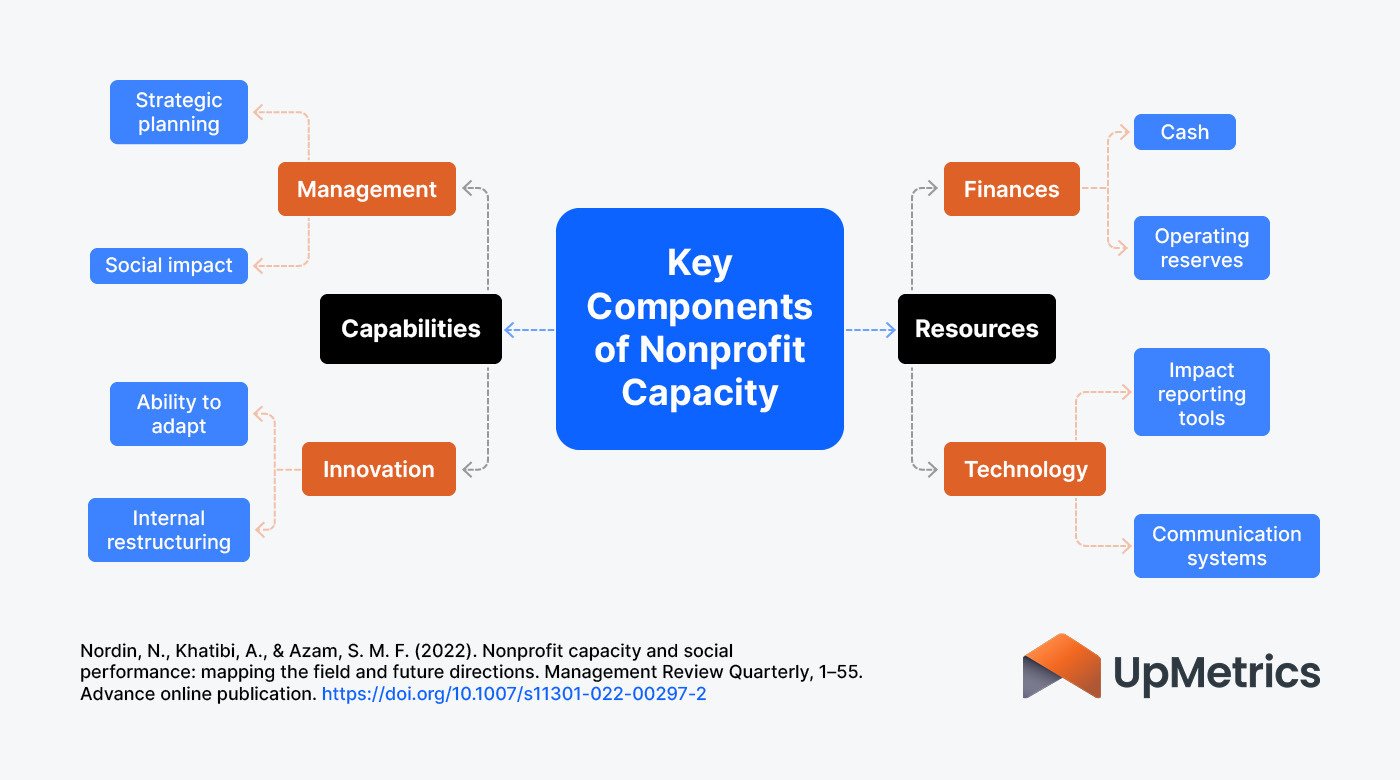
- Resources: This dimension encompasses the tangible and intangible assets an organization possesses that are necessary to carry out its work.
- Examples include financial resources, such as the organization’s cash or operating reserves, and technological resources, such as impact reporting tools or communication systems.
- Capabilities: This dimension refers to the skills, processes, and structures that enable an organization to utilize its resources to achieve its mission.
- Examples include organizational management, such as strategic planning, and long-term innovation, such as internal restructuring.
Within each of these main categories, your organization will find subcategories that relate to its specific operations and needs. A targeted approach to capacity building is essential to ensure the organization focuses its efforts where they’ll yield the greatest return on investment by increasing its social impact.
What are the benefits of capacity building?
Capacity building strengthens an organization’s overall infrastructure, providing a solid foundation to pursue its mission-critical goals. This isn’t just a theoretical concept; Industry leaders widely agree that there’s a correlation between strong nonprofit infrastructure and better long-term outcomes.
Investing in capacity building is crucial because it systematically addresses and enhances the core components of organizational health and performance, leading to several key benefits:
- Stronger organizational health: When a nonprofit cultivates a resilient internal environment, it’s better positioned to retain talent, manage transitions, and stay focused on its core mission.
- Improved operational efficiency: Optimizing core processes, like delivering programs and measuring impact, directs more resources toward tangible outcomes. In other words, capacity building helps nonprofits make the best use of their limited resources.
- Innovation: Capacity building creates the necessary headspace and stability for an organization to look forward and adapt. It provides the tools and confidence to experiment with new program models, embrace technology, analyze data for deeper insights, and respond creatively to evolving community needs and challenges.
What are some capacity-building examples?
While capacity building looks different for every organization, there are a few common areas of focus that many nonprofits prioritize. Here are three examples of what capacity building for nonprofits might look like:
- Strategic planning: Reevaluate your nonprofit’s roadmap to achieving its highest-level objectives. Is your staff working toward the same future? Capacity building in this area involves maximizing resource allocation and providing a clear direction for growth and impact.
- Staff training: Many nonprofits dedicate resources to continuously improve their employees’ knowledge, skills, and competencies. Examples include offering specialized workshops on new methodologies, funding certifications or advanced degrees, or establishing mentorship programs.
- Technology investments: Nonprofits increasingly rely on technology for mission-critical tasks, and adopting specialized systems can directly affect your organization’s ability to operate effectively. Capacity building in this area involves assessing your current tech stack and upgrading systems where necessary to reduce administrative burden.
5 Steps for Nonprofit Capacity Building
Using a capacity-building framework provides a structured approach to improving your organization’s infrastructure and overall sustainability. It focuses on strengthening the internal systems that allow your programs to achieve maximum impact.
While every organization’s approach looks a little different, the steps below can serve as a starting point:
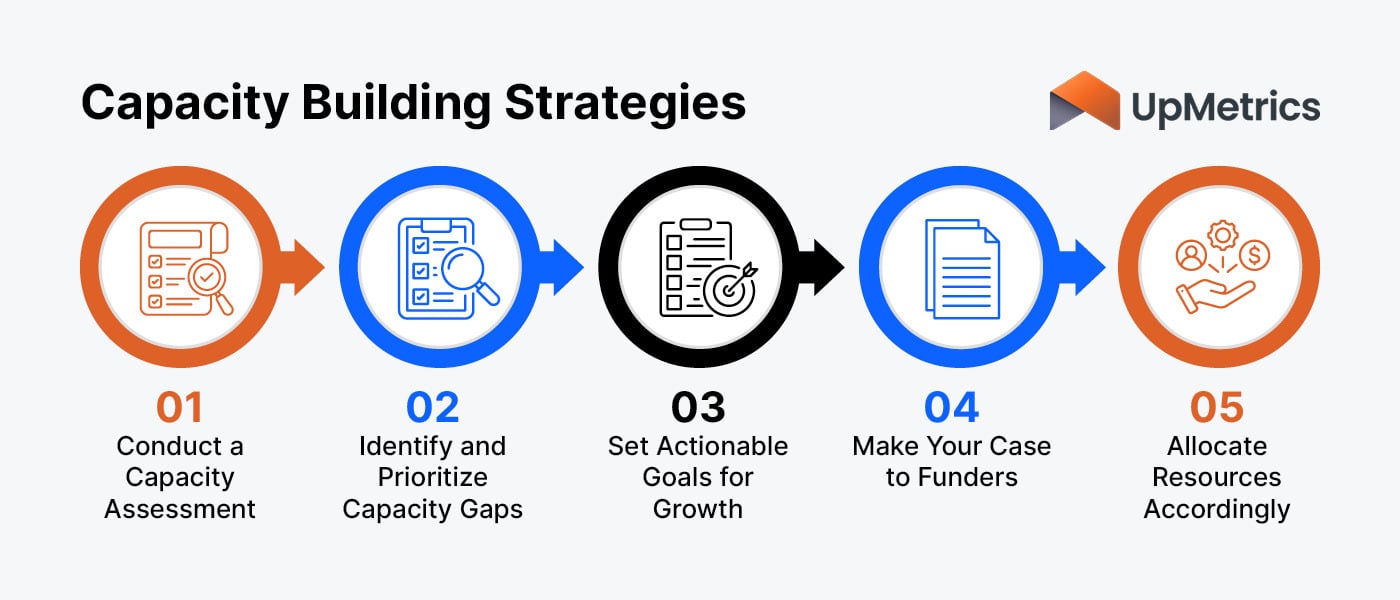
1. Conduct a Capacity Assessment.
You can’t improve what you haven’t measured. The first step in any capacity-building effort is a thorough assessment of your organization’s current strengths and, more critically, your operational weaknesses.
A comprehensive assessment should cover all major organizational domains, including:
- Leadership and governance
- Financial management
- Human resources and talent management
- Program management and impact
- Technology
Nonprofits can use tools like TCC Group’s Core Capacity Assessment Tool (CCAT®) to assess their capacity in depth. However, if you want a quick, high-level overview, answer the questions in the quiz below:
2. Identify and Prioritize Capacity Gaps.
After you’ve completed your assessment, the next step is to identify the constraints currently hindering your organization's sustainability. Define the areas where your organization's current capacity falls short of its strategic needs, and be specific about the root cause in each. Examples could include:
- Human capital gaps: Do you lack specialized talent, such as qualified data analysts, grant writers, or project managers? High staff turnover and insufficient professional development opportunities also fall under this category, indicating a capacity weakness in retention and skill growth.
- Technological gaps: Is the constraint rooted in outdated or inadequate infrastructure? Examples include software that can’t handle your current data volume, or a lack of integrated databases (e.g., CRM, financial tools, program tracking).
- Process and operational gaps: Are your workflows inefficient, redundant, or poorly documented? This might involve cumbersome internal approval processes or fragmented communication channels.
- Financial and resource gaps: Look for an over-reliance on a single funding stream, inadequate reserves, or insufficient capacity in financial planning and budgeting necessary for scaling operations.
Keep in mind that not all gaps require immediate or equal attention. Base your capacity-building prioritization on a gap's potential impact on the organization's core mission, long-term resilience, and ability to scale. Here are some questions to ask yourself to narrow down your top priorities:
- Which gap, if left unaddressed, poses the greatest threat to achieving your core programmatic goals?
- Which intervention promises the most significant return on investment, particularly in terms of social impact?
- How quickly and realistically can your organization close this gap, given current resources?
- Does closing one gap (e.g., investing in a new CRM system) automatically mitigate or simplify another gap (e.g., reducing the manual burden on program staff)?
3. Set Actionable Goals for Growth.
Now you know which areas need the most support, but how do you go about addressing them? Using the gaps defined in your capacity assessment, create goals that follow the SMART framework:
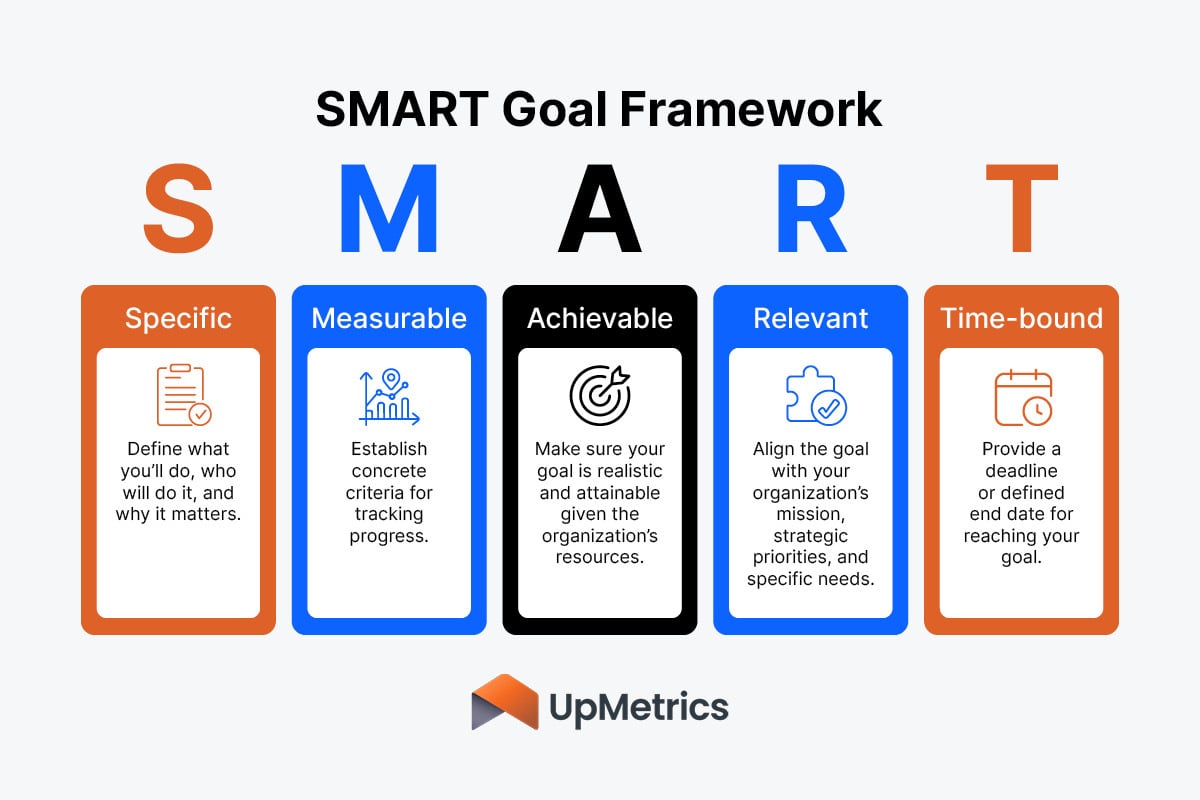
- Specific: Define what you’ll do, who will do it, and why it matters. Avoid ambiguity. The goal should target a single, distinct outcome.
- Example: Invest in a new cloud-based impact reporting tool to centralize data collection.
- Measurable: Establish concrete criteria for tracking progress and determining when you’ve met your goal. Use quantifiable metrics, such as percentages or numbers.
- Example: Acquire an impact reporting tool to reduce the average time spent on manual quarterly impact reporting by 50%.
- Achievable: Make sure your goal is realistic and attainable given the organization's resources, time frame, and current capacity.
- Example: Spend the organization’s technology budget surplus on an impact reporting tool.
- Relevant: Align the goal with your organization's mission, strategic priorities, and the specific needs identified in your capacity assessment. It should contribute meaningfully to the overall strategic vision.
- Example: Use an impact reporting tool to streamline data analysis, which will fuel informed decision-making in program delivery.
- Time-bound: Provide a deadline or defined end date to create a sense of urgency and prevent the goal from being indefinitely postponed.
- Example: Implement an impact reporting tool by the end of the third fiscal quarter (Q3).
Let’s compare a generic goal with a goal that follows the SMART framework outlined above:
- Generic goal: We need better data management and reporting.
- SMART goal: Implement a new cloud-based impact reporting tool by the end of Q3 to centralize data collection and reduce the average time spent on manual quarterly impact reporting by 50%.
By applying the SMART criteria, your organization can link its capacity-building efforts to demonstrable, positive changes in performance and impact.
4. Make Your Case to Funders.
When it's time to put your plan into action, you may feel constrained by program-specific funding. But the truth is, capacity building is what makes your programs possible, and communicating this need to funders is the key to securing the resources you really need to accelerate your mission.
Successfully making your case to funders involves clearly articulating the need in relation to the core operational and structural elements that underpin effective program delivery. Helpful strategies include:
- Focusing on outcomes: Instead of only emphasizing your nonprofit’s need, go a step further by explaining what you’ll accomplish with the funder’s investment.
- Incorporating data: Share impact data and case studies that demonstrate how past capacity investments are already making a difference.
- Highlighting collaboration: Invite funders to be part of the process, showing your commitment to systemic improvement rather than a singular project.
The goal is to shift the conversation with funders to emphasize organizational outcomes and long-term resilience. Make it clear that investing in your organization’s capacity is the most effective way to ensure your programs are scalable, sustainable, and capable of achieving maximum impact.

5. Allocate Resources Accordingly.
Once you’re ready to execute your capacity-building strategy, you’ll need to allocate the necessary resources toward the solutions you identified to close your capacity gaps. This could include:
- Human resources: Delegating staff to capacity-building tasks or hiring new talent to manage the process
- Technology: Purchasing and deploying new systems that you identified in the capacity assessment phase
- Training: Investing in professional development for team members to ensure they’re prepared to adopt new tools and processes
Capacity Building Challenges (and Solutions!)
While capacity building holds great potential for increased organizational effectiveness and impact, a few barriers can derail progress. Common challenges to capacity building include:
Miscategorization As Overhead
Capacity-building can be miscategorized as “overhead” because team development or technology investments inherently increase an organization’s administrative costs. Donors may worry that an increasing overhead percentage is a sign of inefficiency.
The solution: Be prepared to reframe the narrative. Educate funders and donors on the necessity of capacity building by connecting these costs to mission-critical outcomes.
Improper Technology Usage
Although certain tools can improve organizational productivity, their improper use can lead to serious consequences, such as data breaches. Staff members who lack familiarity with new technologies like artificial intelligence (AI) don’t have the experience needed to adopt these tools safely, effectively, and strategically.
The solution: Train team members to use your technology ethically. Ensure all training covers technical execution, strategic integration, and risk mitigation.
Final Thoughts on Capacity Building
Capacity building is not a distraction from your mission; it’s the engine that drives it. With a radical approach to organizational health, you can move your organization from a state of fragility to one of lasting impact.
As you begin this journey, remember that true capacity is built on the people behind your programs. If you want to learn more about a collaborative approach to social impact, check out the following resources:
- Participatory Grantmaking Principles, Potential, and More
- Trust-Based Philanthropy: A Guide for Impact-Minded Orgs
- The Ultimate Beginner's Guide to Nonprofit Storytelling