10 Top Impact Measurement & Reporting Software Tools
Whether you’re a nonprofit, a grantmaker, or an impact investor, you face pressure from various stakeholders to demonstrate clear evidence of your impact and continually learn and improve. Historically, even large operations were stuck using a patchwork of solutions not built for impact measurement. This approach is not only inefficient, but also makes it harder to understand the real stories behind your data.
However, modern impact measurement software replaces these manual tracking methods with centralized data collection, real-time visual analytics, and tools for sharing your impact story with external audiences. Selecting a purpose-built platform helps your team evaluate program performance while building stronger relationships with partner organizations.
To guide your evaluation, this guide breaks down the ten leading software tools on the market today and outlines the key capabilities you should look for.
.webp?width=2400&height=1200&name=trust-based%20philanthropy%20-%20top%20CTA%20(1).webp)
Impact Measurement Software FAQs
What does impact measurement software do?
Impact measurement software helps organizations define, track, analyze, and communicate the real-world impact created by their programs or investments. These platforms unify:
- Strategic impact framework design
- Multi-source quantitative Key Impact Indicators (KII) and qualitative story collection
- Collaborative two-sided reporting workflows with submission tracking
- Real-time visual analytics
- Shareable public dashboards within a single system.
Here are some examples of generic tools that impact funders have historically stitched together in an attempt to create a complete solution, as well as the strengths and shortcomings of each one:
|
Software Category |
Typical Use Case |
Core Strengths |
Key Limitations |
|
Spreadsheets & Manual Forms |
Basic data logging for early-stage or small-scale programs. |
Low cost, universally familiar, easy setup. |
Significant manual effort required, error-prone, no portfolio aggregation or real-time data visualization. |
|
Standalone Survey Tools |
One-off feedback collection and constituent polling. |
Simple form building, flexible distribution. |
Lacks shared framework mapping, portfolio dashboarding, and recurring reporting logic. |
The option that provides the best combination of these tools is a comprehensive impact measurement and reporting platform. These platforms help you develop your impact framework, collect impact data, and report on it so you can communicate your organization’s great work. We’ll review the best impact measurement software later.
What are the benefits of using impact measurement software?
Purpose-built software shifts your organization's focus away from tedious administrative tasks toward growth and relationship building. Unifying your strategy, data collection, and reporting within a single platform gives you advantages across every level of impact production and reporting.
Benefits for your organization
- Accelerated strategic decision-making: Continuous data streams flag operational risks early, giving your leadership team the foresight to pivot quickly and allocate resources effectively.
- More efficient administration: Automation handles manual tasks, such as data collection follow-ups and reporting, freeing your team to devote energy to hands-on mission work.
- Stronger fundraising position: Presenting audit-ready, interactive reports builds immediate credibility with board members, major donors, and prospective investors during capital raises.
- Deeper partner trust: Shared data visibility improves your collaborative dynamics, replacing transactional reporting checks with a transparent partnership built on mutual accountability.
- Complete narrative context: Linking field notes, photos, and constituent quotes directly to quantitative data presents a complete, humanized account of your community progress.
- Enterprise-grade data security: SOC 2 Type 2 compliance audits and role-based access controls safeguard sensitive constituent data and financial records.
Benefits for the organizations you're requesting data from
- Decreasing reporting fatigue: Dedicated workspaces allow grantees, chapters, or portfolio companies to save draft progress, collaborate internally, and easily reuse past submissions across multiple funder requests.
- Tailored, relevant inquiries: Conditional form logic hides unnecessary fields, ensuring responding organizations only spend time answering questions tied to their actual scope of work.
What features should we consider when choosing impact measurement software?
Selecting the right software platform requires evaluating the specific functional tools that support your team throughout the entire reporting cycle.
When comparing software vendors, evaluate their core capability set across these essential technical features:
- Customizable framework builders that help you map strategic objectives, indicator hierarchies, and causal logic paths.
- Centralized data integrations that bring in data from external tools and share it seamlessly with your existing toolset.
- Ability to capture qualitative information so you can organize constituent quotes, field notes, news articles, and more alongside quantitative data.
- Two-sided reporting portals where partner organizations complete data requests, store draft entries, and view past records, while your organization can easily view submission status and approve or request changes to submitted data.
- Conditional form logic that shows or hides specific questions based on a respondent's previous answers or sector focus.
- Submission tracking engines that display real-time form progress, send automated reminders, and log revision requests.
- Advanced visual analytics that help you dynamically explore and present data.
- Public dashboard links that allow you to filter, drill into, and explore data from every angle to reveal meaningful insights and answer emerging questions on the fly.
- SOC 2 Type 2 security, which safeguards confidential organizational data with granular permission controls and audited encryption.
What is an impact framework?
An impact framework is a structured resource used by mission-driven organizations to define clear goals, objectives, and strategies, aligning the many roles within an organization toward a common vision. Here are some examples of impact frameworks:
- Theory of Change (ToC): A framework that maps the strategic activities, assumptions, and causal pathways required to reach a specific long-term impact.
- Social Return on Investment (SROI): A methodology (divided into Forecast and Evaluative types) that assigns monetary value to social, economic, or environmental changes.
- IRIS+: A catalog of generally accepted, standardized metrics managed by the Global Impact Investing Network (GIIN) to measure and compare performance.
- UpMetrics’ Impact Framework: A model that evaluates progress by structuring outcomes across five core dimensions: Who, What, Quality, Better Off, and Community Contribution. Our framework has three components: KIIs, Objectives, and Dimension of Impact.
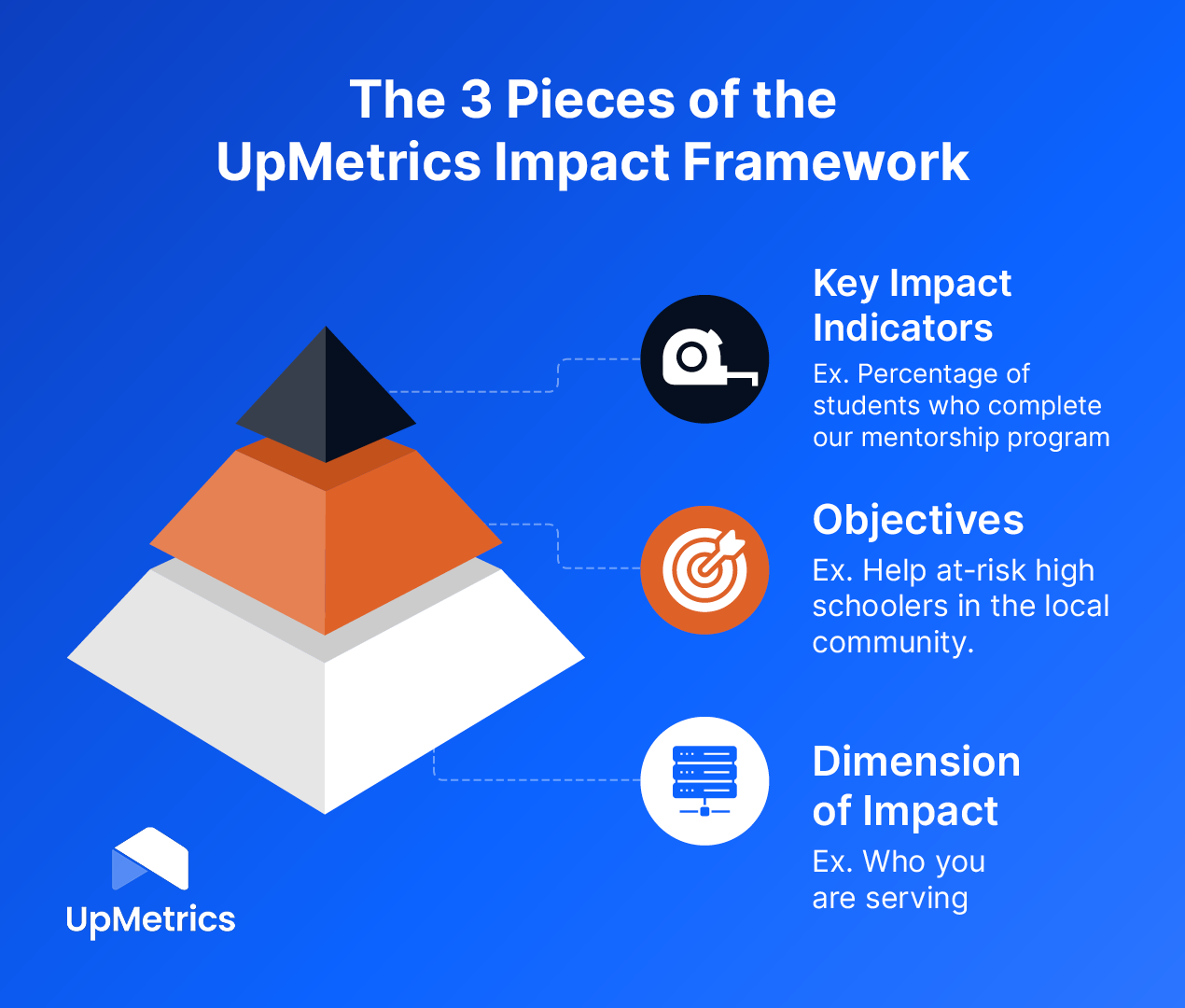
Digitizing your impact framework on a dedicated platform makes your strategic blueprint actionable. The framework defines what data matters and why, while the software automates how that data is collected and organized.
This integrated approach provides these practical benefits:
- No manual data cleanup: Because software lets you pre-configure field validation rules (like requiring number-only inputs or forced dropdowns), submitted data lands in clean database fields. The software also automatically blocks misformatted text, eliminating the hours you normally spend fixing broken spreadsheets.
- Easier portfolio alignment: Built-in tooltips and guided entry forms inside the software ensure that every fund recipient answers creates reports using identical criteria. Since the software removes ambiguity about what a metric actually measures, progress reviews focus on the real strategy rather than arguing over definitions.
- Faster setup with standard templates: Software platforms come preloaded with digital taxonomies and impact frameworks built directly into their form builders. Instead of spending weeks designing survey forms and mapping formulas manually to align with your impact framework, you can load pre-configured data pipelines and start collecting data with the push of a button.
10 Top Impact Measurement Software Solutions
Top Impact Measurement Software Overall: UpMetrics
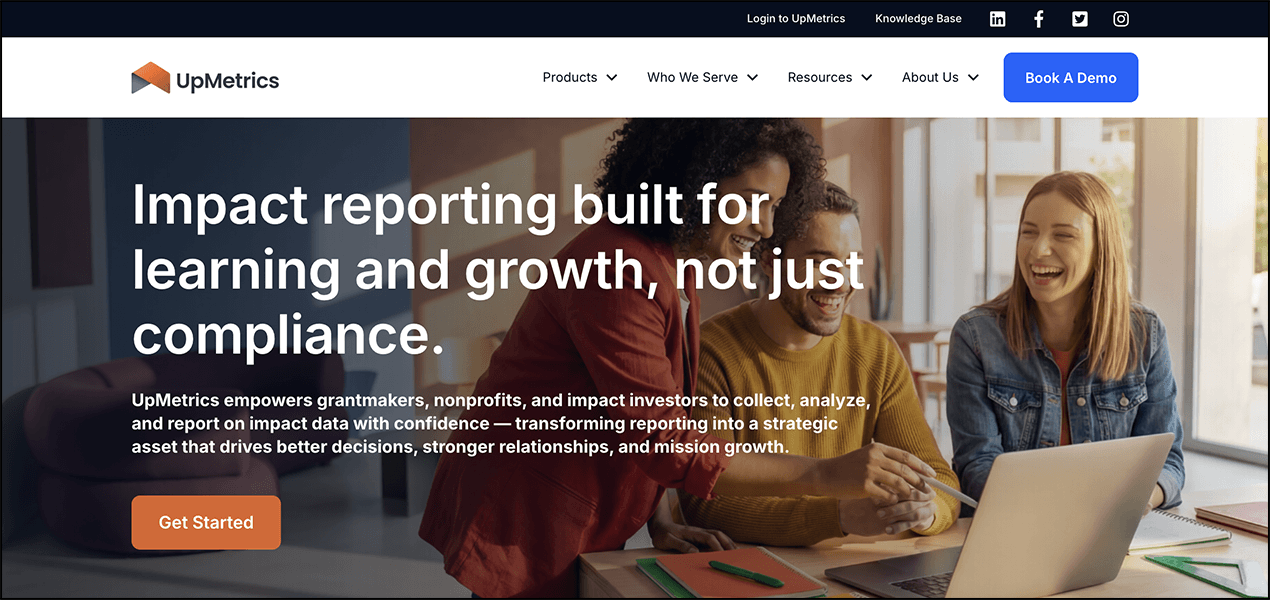
UpMetrics is purpose-built to manage the entire capital-to-impact lifecycle in a unified system. Here’s why nonprofits, grantmakers, and impact investors are switching to UpMetrics:
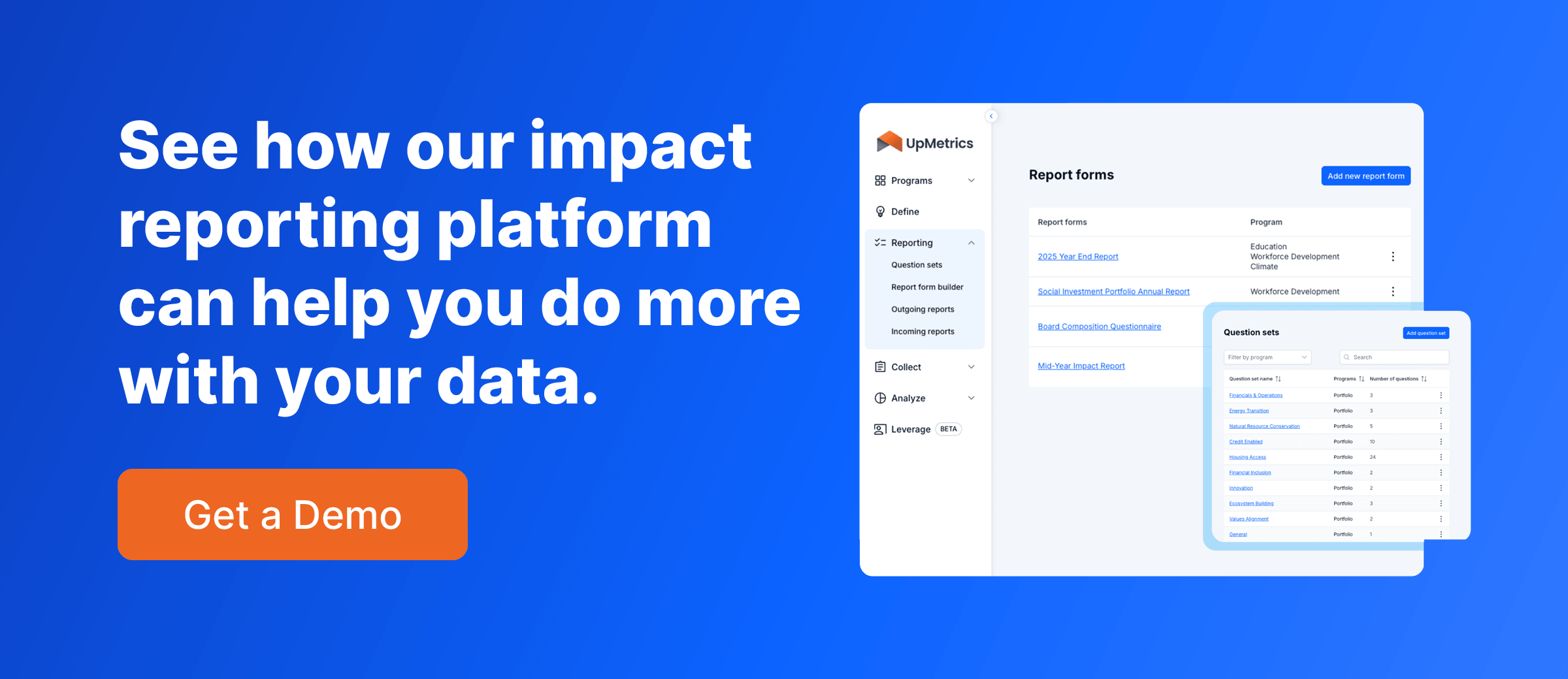
- Two-sided collaborative portals. Traditional surveys act as a one-way data extraction. UpMetrics provides a collaborative, two-sided reporting portal where the partner organizations you're requesting data from receive a free account to enter metrics, save drafts, collaborate with teammates, and view their historical trends.
- Framework-agnostic flexibility. UpMetrics adapts to your preferred impact framework, easily adjusting dimension labels while keeping the underlying "shared skeleton" of your data organized.
- Fund-level intelligence. Define core KIIs across a fund for aggregate portfolio reporting, while still giving individual investees the flexibility to track custom, company-specific metrics unique to their business models.
- Qualitative stories as first-class data. UpMetrics’ new Stories feature allows you to capture the qualitative context behind your impact, then code and categorize stories based on program affiliation, impact themes, sentiment and more to effectively label and organize them in a way that makes them just as measurable as quantitative data.
- Automated data pipelines. Directly connect to your existing toolset with our integrations. For instance, you can connect your Google Sheets account and sync it to ensure your active dashboards update automatically as your spreadsheets change.
- Presentation-ready reporting. Convert raw portfolio metrics into dynamic, visual dashboards. The platform lets you share live, secure insights with key stakeholders via public dashboard links or export polished charts for board decks.
- SOC 2 Type 2 security. Protect sensitive data with granular, role-based user permissions and independently audited, enterprise-grade security standards.
Pricing
UpMetrics offers multiple pricing options for both nonprofits as well as funders (foundations and impact investors) based on the number of users, dashboards, and data tables required, so you can choose the plan that works best for your needs.
Grantmakers & Foundations
GivingData

GivingData (a Foundant company) is an enterprise grantmaking platform engineered to align foundation workflows with outcome tracking and board reporting.
Features
- Integrated grantee portal for application intake, progress report collection, and direct messaging
- Financial dashboards that track grant disbursements, docket reviews, and payment approvals
- Foundation CRM functionality, including interaction logs, donor history, and relationship mapping
Pricing
Tiered subscription plans tailored to foundation asset sizes (contact GivingData for a custom price quote).
Amp Impact (by Vera Solutions)
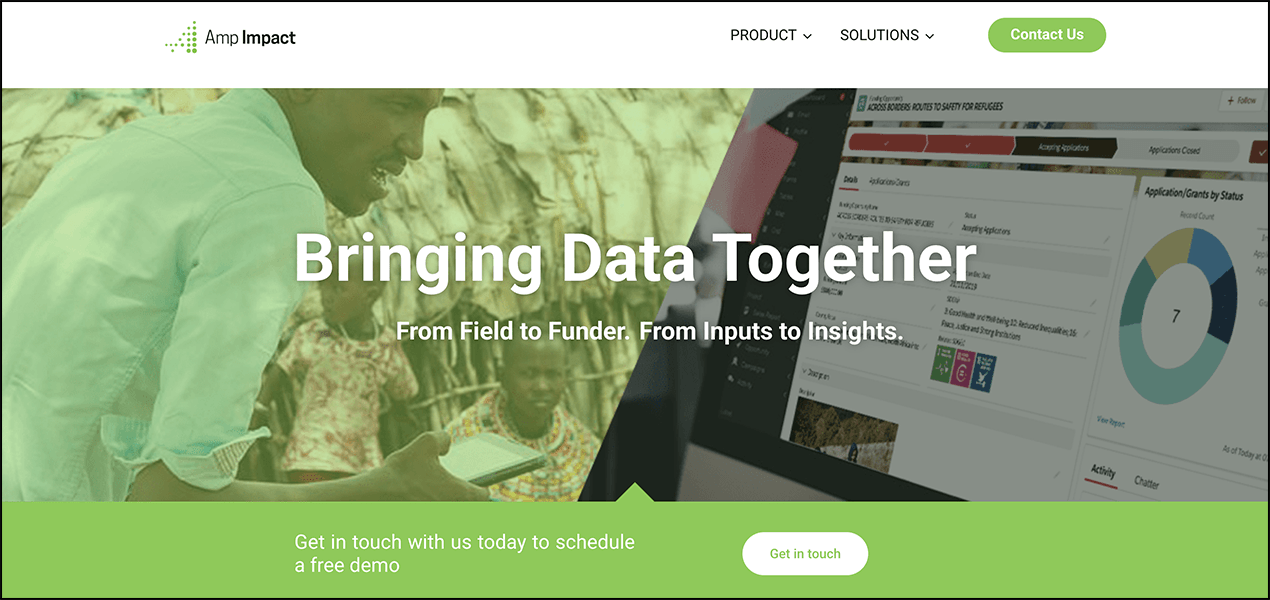
Amp Impact is a portfolio management and impact tracking application built natively on Salesforce for grantmakers and non-governmental organizations.
Features
- Salesforce-native application that integrates grant tracking fields, budget management, and metric inputs
- Multi-level indicator management that tracks targets against actual entries across custom frameworks, logframes, and IATI standards
- Portfolio aggregation modules that calculate results across international initiatives, thematic categories, and geographic locations
Pricing
Custom enterprise pricing based on solution complexity, implementation scope, and organizational capacity.
True Impact
True Impact is a web-based evaluation platform built for corporate philanthropy and social responsibility teams to calculate return on investment.
Features
- CSR donor dashboard for monitoring cash grants, employee volunteer hours, and in-kind contributions
- Outcome modeling formulas that convert activity metrics into social benefit estimates
- Standardized reporting templates for mapping internal community activities to financial materiality standards
Pricing
Custom enterprise subscription pricing based on corporate giving volume and platform scope.
Impact Investors
Sopact

Sopact is an AI-native intelligence platform that automates data extraction and outcome analysis from unstructured stakeholder feedback.
Features
- Natural language processing tools for open-text survey data, interview transcripts, and case notes
- Unified evidence logs connecting intake records, field notes, and milestone data per investee
- Mapping engines that link qualitative text and quantitative metrics to theories of change and SDGs
Pricing
All-inclusive platform pricing with no per-user license fees (custom quotes provided based on scope).
Proof
Proof is a sustainability data analytics platform built for private equity funds, venture capital firms, and corporate managers tracking environmental and social metrics.
Features
- Statistical benchmarking models displaying portfolio company metrics against peer percentile charts
- Automated SWOT analysis tools that evaluate reported metrics to highlight operational risk and opportunity categories
- GIIN IRIS+ core metric catalogs that integrate directly within the platform interface
Pricing
Tiered subscription levels ranging from a free Baseline access tier up to enterprise Insights and Outcomes plans (contact Proof for custom tier pricing).
The Upright Project
The Upright Project uses a scientific mathematical model to measure the net impact and double materiality of corporate entities and investment portfolios.
Features
- 19-category net impact model that calculates positive and negative externalities in monetized values
- CSRD double materiality assessment tools aligned with European ESRS reporting guidelines
- Revenue-based SDG alignment mapping across product lines, service models, and supply chain activities
Pricing
Custom enterprise subscription tiers available based on portfolio scope and dataset access (no public pricing listed).
Nonprofits & Service Providers
SureImpact
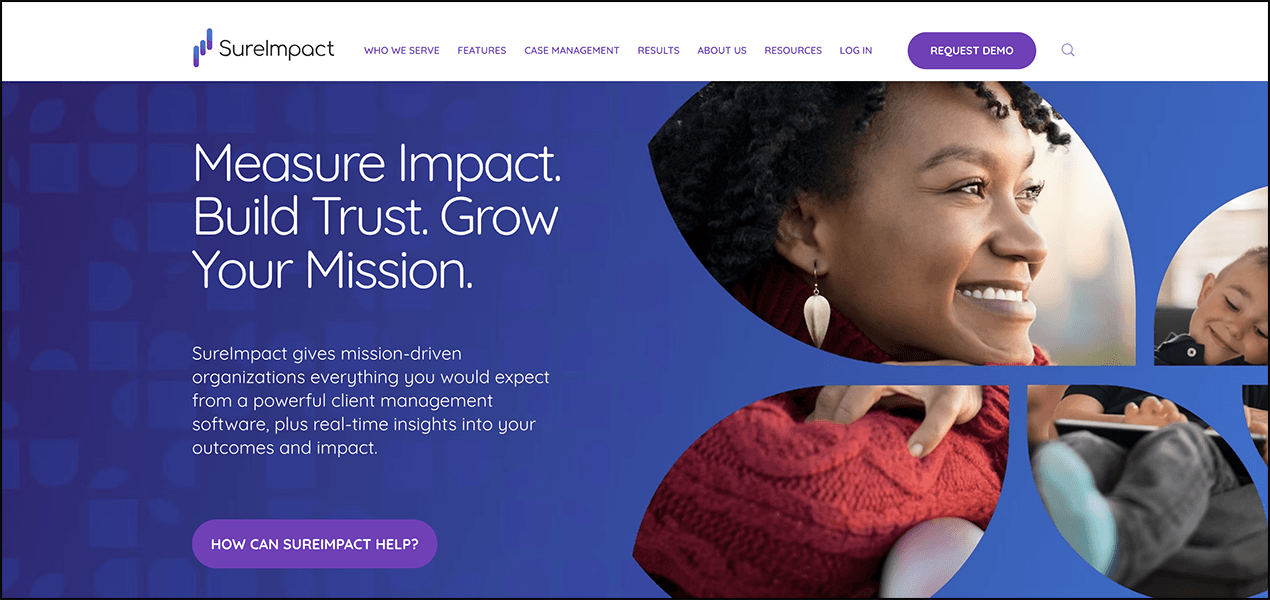
SureImpact is a cloud-based case management and impact tracking system built for nonprofit community service providers and government agencies.
Features
- Person-centered case management fields for tracking participant demographics, direct service records, and goal status
- Standardized outcome library featuring 400+ pre-configured indicators and custom metric tools
- SROI calculators that convert individual program achievements into economic value metrics
Pricing
Subscription-based licensing model tailored to organization size and user seats (contact SureImpact for a custom quote).
ImpactMapper
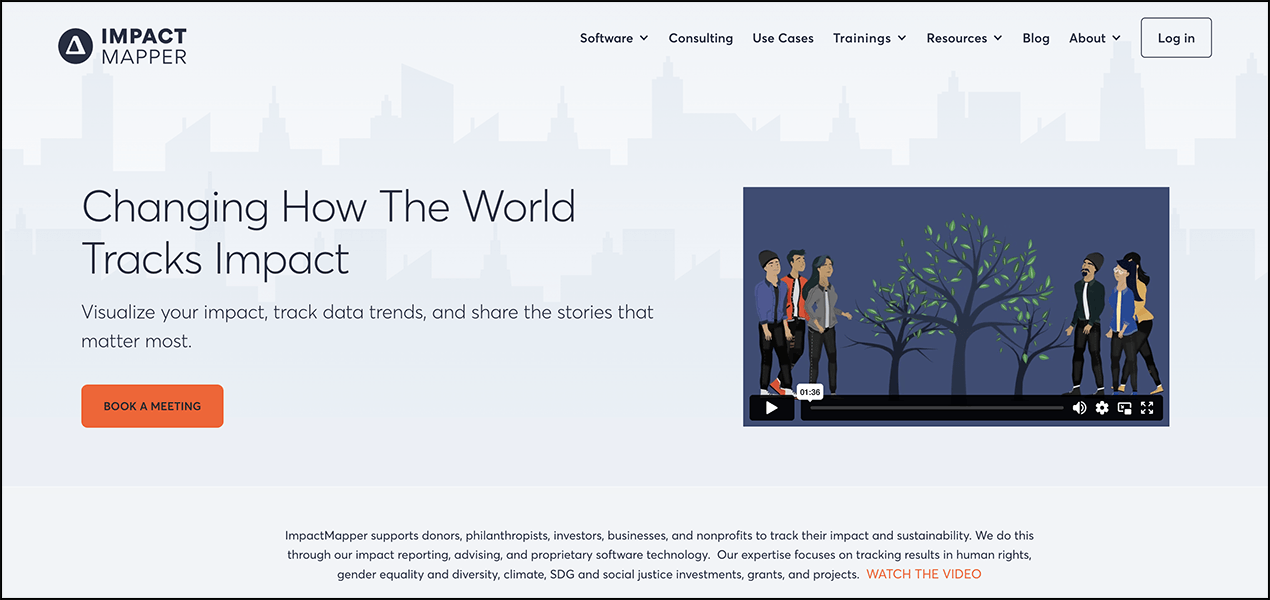
ImpactMapper is an evaluation platform designed for nonprofits that analyzes qualitative field data alongside quantitative indicators.
Features
- Qualitative text analysis tools for extracting trends and key themes from field stories and open-text surveys
- Data visualization modules that convert survey records into exportable charts and visual summaries
- Custom form builder designed for constituent polling, baseline assessments, and narrative collection
Pricing
Publicly listed annual plans start at $75/user/month for basic survey access; full platform subscriptions range from $5,500/year (nonprofits) to $15,000/year (foundations) plus setup fees.
Resilia
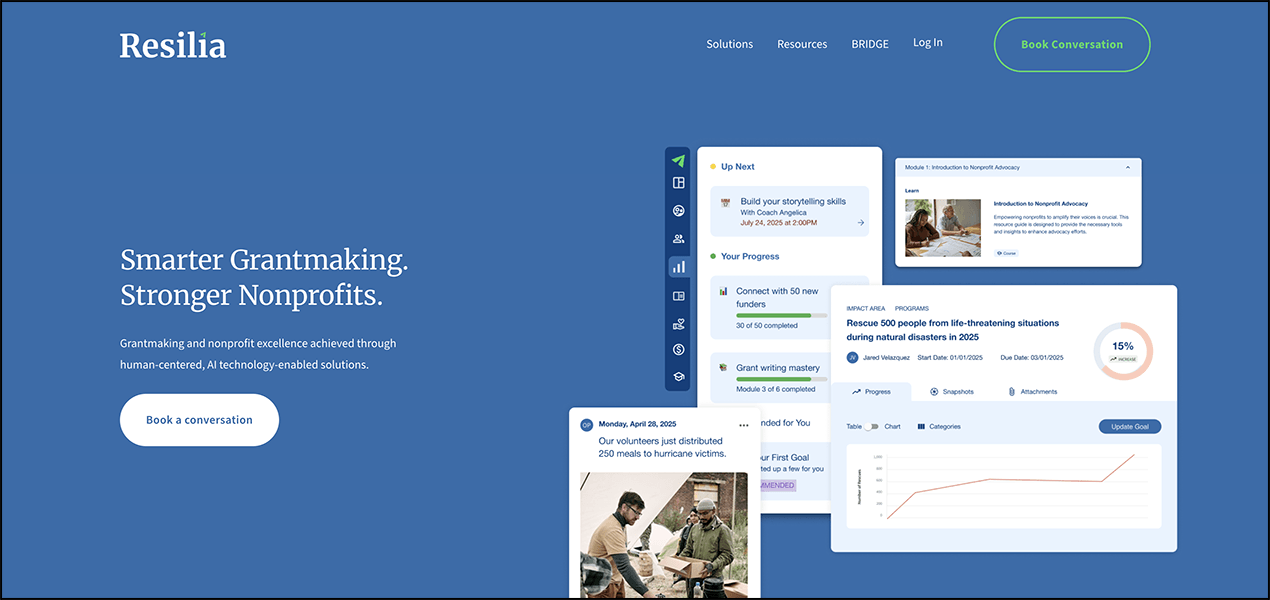
Resilia combines impact reporting software with direct capacity-building support and coaching for operating nonprofits and grassroots organizations.
Features
- Educational resource hub providing on-demand courses, policy templates, and operational guides
- Scheduling portal for 1-on-1 expert coaching on fundraising, governance, and evaluation
- Funder-sponsored platform portal enabling outcome tracking alongside capacity-building workflows
Pricing
Free lifetime community access for sponsored nonprofits; paid Pro memberships and custom grantmaker subscription tiers (pricing available upon inquiry).
Using a purpose-built solution like UpMetrics fundamentally changes how your organization understands and communicates its real-world impact. When qualitative constituent stories and quantitative indicators live side by side in real-time dashboards, you gain the clarity needed to refine your programs, build trust across your portfolio, and demonstrate your performance with total confidence.
Additional resources:
- Participatory Grantmaking Principles, Potential, and More. Participatory grantmaking is a philanthropic approach that transfers decision-making power to the communities affected. Read this article to learn more.
- Social Impact: Meaning, Importance, and How to Measure It. Social impact refers to an action’s positive or negative effects on individuals and their communities. Learn what it means for your organization here.
- What Is Capacity Building? A Guide to Building Resilience. Capacity building is the process of strengthening an organization to ensure long-term sustainability. Learn how to grow your organization in this guide.
.png?width=2400&height=1200&name=CTA%202%20(3).png)