
Impact Data Collection from Investees: A Strategic Guide
Managing an impact fund comes with a unique double mandate: you have to deliver financial returns and prove the real-world change your capital creates. That second mandate used to be manageable with a few portfolio companies and customized spreadsheets. But as your portfolio scales, collecting clean, timely impact data from investees can quickly turn into a messy operational headache.
The shift toward impact isn't slowing down. According to recent research from Cambridge Associates, 69% of consistent respondents reported integrating sustainable and impact investing into their portfolios, up from 45% in 2020. As more capital moves into the space, asset owners expect clear, verifiable proof of impact. In this guide, we’ll explore how to collect data from impact investees efficiently and accurately to secure your fund’s future.
Table of Contents:
- Impact Investee Data Collection FAQs
- Features to Look for in Impact Data Collection Tools
- Best Practices for Collecting Impact Investee Information
Impact Investee Data Collection FAQs
What is impact data collection?
Impact data collection is the process of gathering performance metrics directly from portfolio companies. These data points measure the tangible social or environmental outcomes your investees generate, like metric tons of carbon avoided, net new living-wage jobs created, or underserved individuals who have gained access to healthcare.
What are the most common challenges of collecting impact data from investees?
Impact data collection, while essential, can quickly become cumbersome if fund managers have to constantly reach out to investees, manually log information, and keep databases clean. Most funds encounter these same structural bottlenecks:
- Spreadsheet overreliance. Managing dozens of individual spreadsheets leads to broken formulas, version control confusion, and wasted admin time.
- Mismatched timelines. Portfolio companies operate on different financial schedules, making synchronized quarterly or annual reporting tricky.
- Inconsistent metrics. Without clear guidance early on, investees might measure outcomes in custom formats that can't be easily combined at the fund level.
- Reporting fatigue. When impact reporting feels like an administrative chore, response rates drop, and data quality suffers.
Fortunately, you can mitigate those challenges with two-way data collection workflows.
What’s the best way to collect impact data from investees?
To truly optimize impact data collection from investees, you’ll need the right tools. Using a purpose-built, two-way impact reporting platform allows investees to upload their impact data directly, leading to a more efficient and accurate process. We’ll review more information about impact reporting tools later.
A streamlined two-way data collection workflow directly empowers investees to participate in the process.
- Higher submission rates and better data quality. Simple workflows are more likely to shorten turnaround times, reduce missing data, and provide more accurate impact tracking.
- Immediate value for investees. With the right impact collection and reporting tools, portfolio companies gain instant access to self-service analytics, historical trendlines, and peer benchmarks for their own records.
- Stronger portfolio relationships. Transforming reporting from a one-way compliance task into a collaborative process allows fund managers to deliver targeted operational mentoring and strategic guidance, making the process more meaningful for investees.
How does impact data collection differ from standard ESG or financial reporting?
It’s common for teams to blur the lines between financial reporting, ESG compliance, and impact tracking, especially since the same data can be used across these processes. While all three are essential for portfolio management, they measure distinct dimensions of business performance. Here is how each process differs:
|
Process |
Example Metrics |
Core Question Asked |
Common Frameworks & Standards |
|
Financial Reporting |
Profitability, revenue growth, cash flow, and runway |
"Is this business financially viable and growing?" |
GAAP, IFRS |
|
ESG Reporting |
Operational risk mitigation, regulatory compliance, and governance |
"Is this company operating responsibly and avoiding operational harm?" |
SASB, GRI, TCFD |
|
Impact Data Collection |
Intentional, positive social or environmental outcomes generated by core operations |
"What positive real-world change is being created for people or the planet?" |
GIIN IRIS+, Theory of Change, UN SDGs |
Let’s illustrate how these processes break down with a hypothetical socially responsible business that manufactures and sells pay-as-you-go solar-powered irrigation pumps to farmers in off-grid rural communities:
- Financial reporting: Tracks whether the company is built to survive and scale.
- Sample metrics: $4.5M in Annual Recurring Revenue (ARR), 62% gross margins, customer acquisition cost (CAC), and an 18-month cash runway.
- What it proves: The company has a viable business model capable of generating financial returns for investors.
- ESG reporting: Tracks how the company manages internal risk, its supply chain, and workforce policies.
- Sample metrics: 98% proper recycling rate for end-of-life lithium batteries, formal ethical sourcing audits for solar panel suppliers, and zero workplace injury incidents over one year.
- What it proves: The company operates conscientiously, minimizes supply chain vulnerabilities, and avoids causing environmental or workplace harm while conducting business.
- Impact data collection: Tracks the tangible, intentional social and environmental change caused directly by the product's deployment.
- Sample metrics: 8,500 farming households equipped with clean water access to date, 3,200 total metric tons of carbon dioxide emissions avoided by replacing diesel-powered pumps, and an average 35% net increase in annual farmer income due to year-round crop yields.
- What it proves: The company's core technology is successfully generating impact returns by reducing rural poverty and lowering agricultural emissions.
Features to Look for in Impact Data Collection Tools
Manual, spreadsheet-dependent workflows can only take you so far. Fund managers need tools built for impact reporting that can scale to support a steadily expanding portfolio of companies. When evaluating impact collection and reporting platforms, prioritize these core features:
- Two-sided portals. The platform should work equally well for both sides of the partnership. Fund managers need high-level portfolio aggregation, while portfolio companies need an intuitive portal to enter data, view trends, and pull reports for their own stakeholders.
- Flexible metric aggregation. Early-stage enterprises rarely track impact in the same way. Look for tools that let you track company-specific metrics while rolling up shared data points into fund-level Key Impact Indicators (KIIs).
- Impact framework alignment. Every fund views and tracks impact through different lenses. Choose software that is framework-agnostic and adapts to your chosen approach, whether you follow a Theory of Change, a Logic Model, or a unique impact framework tailored to your specific portfolio.
- Qualitative impact tracking. Numbers show scale, but stories bring impact to life. The best impact platforms allow you to collect qualitative narratives, beneficiary testimonials, and supporting photos alongside quantitative KIIs.
- Easy report generation. You shouldn't have to spend days reformatting data for reports. Look for software that generates clean, presentation-ready dashboards and exports in just a few clicks.
Best Practices for Collecting Impact Investee Information
Streamlining impact data collection comes down to prioritizing clear, predictable workflows. By setting baseline indicators early, automating investee reporting, and sharing useful insights back with your founders, you eliminate barriers and raise data quality across the board. Let’s explore a few ways to make this possible.
Top Best Practice: Use an Impact Reporting Platform
Adopting a dedicated impact reporting platform turns data collection from a compliance chore into a centralized, collaborative ecosystem. But more than just streamlining admin work, the right platform creates a strategic opportunity for investors to actively support and empower investees using the insights generated from collected data.
Impact investors rarely just write checks. They are also hands-on partners, offering strategic, operational, and governance guidance alongside financial capital. When reporting workflows are designed as a two-way street, investors can analyze cross-portfolio trends, share benchmarking insights with founders, and offer concrete recommendations for operational improvement.
The Leading Impact Reporting Platform: UpMetrics
To help funds move from simple data extraction to true portfolio management, UpMetrics provides purpose-built tools designed for impact investors. Some of our solution’s features include:
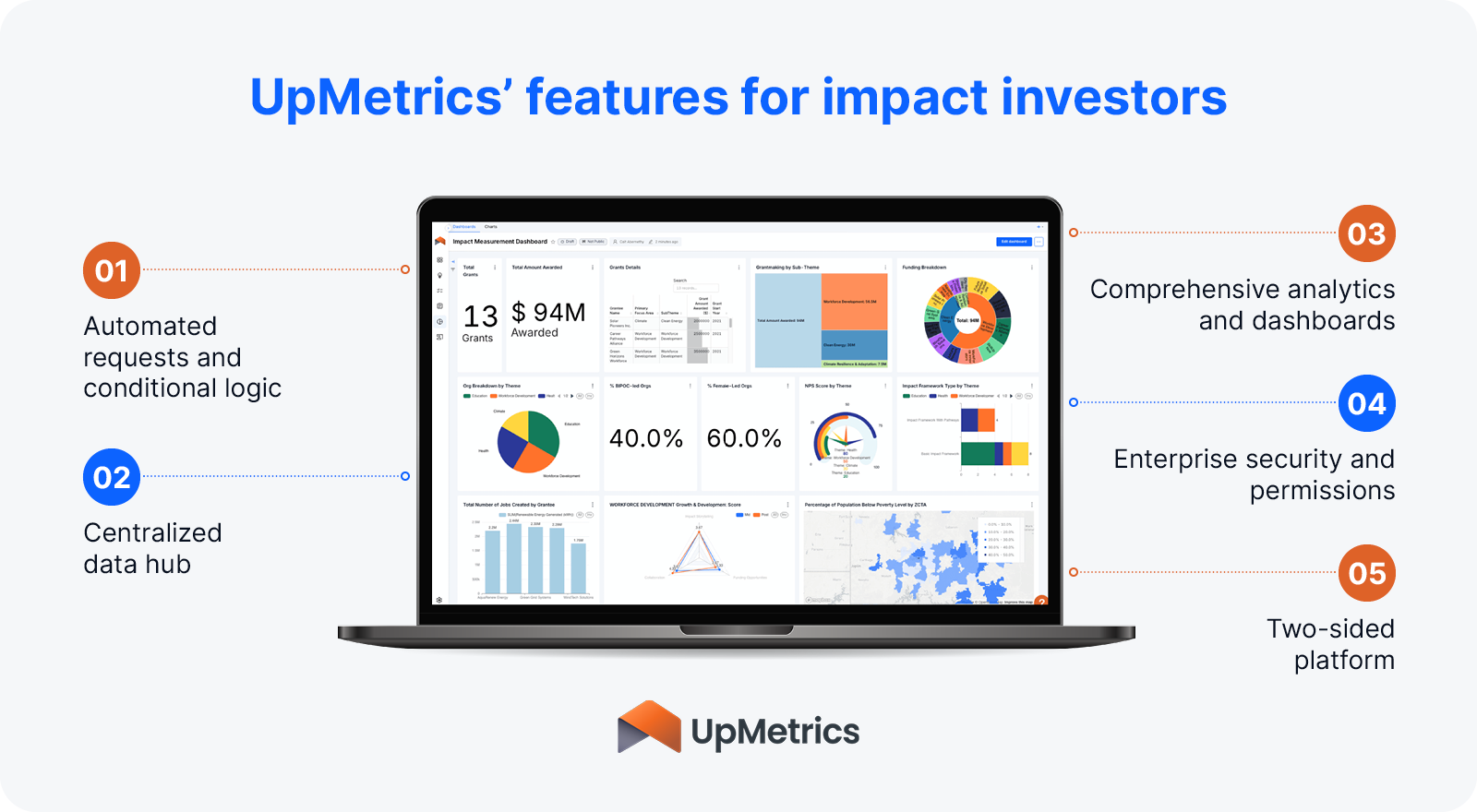
- Automated requests and conditional logic. Pre-build reporting templates, use conditional logic so companies only see fields relevant to their business model, send automated reminders, and track submission status in real time.
- Centralized data hub. Keep all of your data safely organized in a single, reliable database so you can pull the strongest insights quickly.
- Comprehensive analytics and dashboards. Instantly convert raw portfolio inputs into dynamic, presentation-ready visualizations for investor updates, board presentations, and internal reviews.
- Enterprise security and permissions. Ensure sensitive portfolio company financials and operational metrics remain fully protected with granular, role-based access controls.
- Two-sided platform. Fund managers invite portfolio companies into dedicated portals where they can easily submit data, review historical trends, and access self-service analytics. That way, they can support their own PR, recruiting, and fundraising efforts.
Other Investee Impact Data Collection Best Practices
In addition to using the right software, adopting these operational habits can dramatically improve your data collection experience:
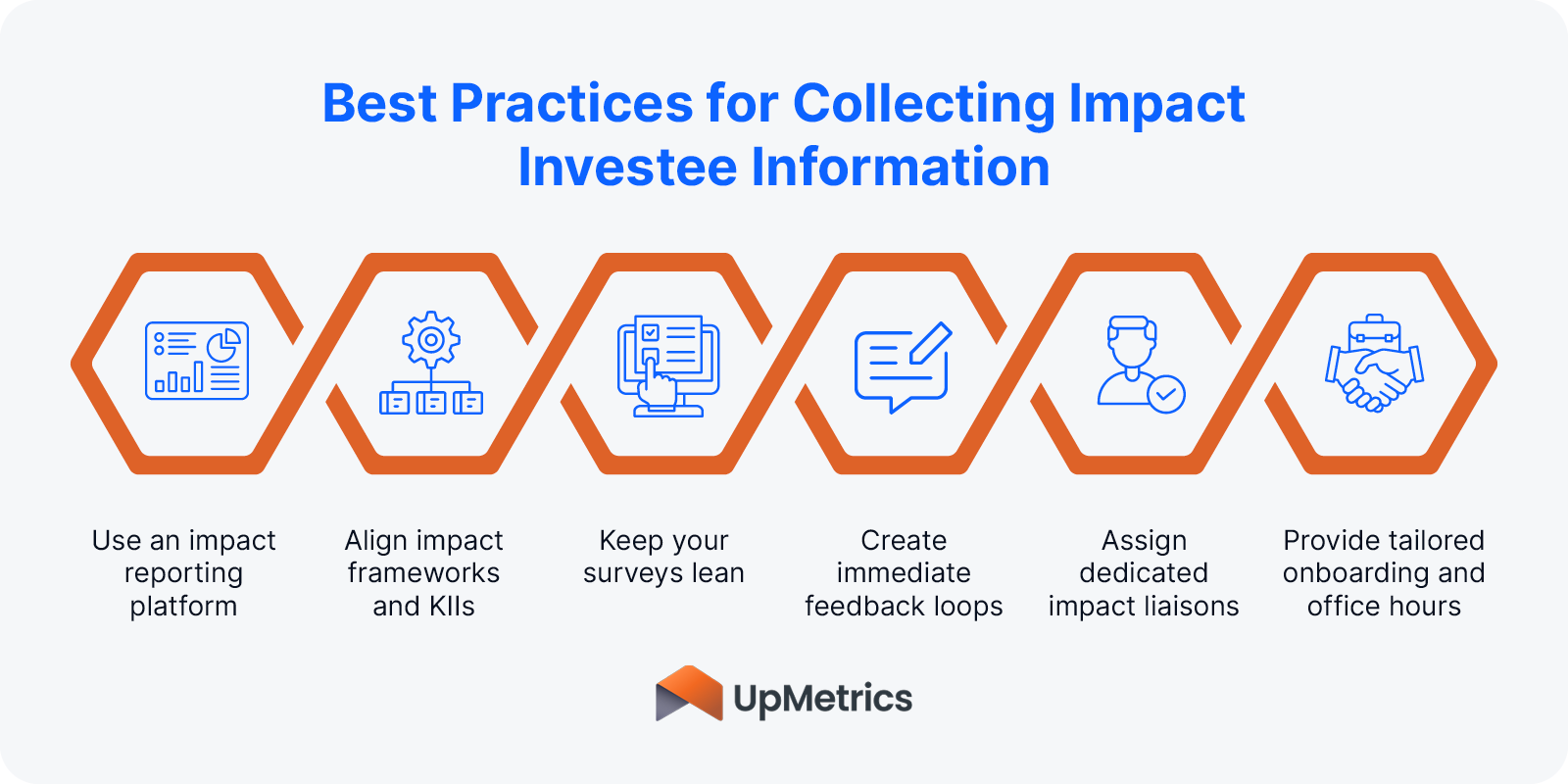
- Align impact frameworks and Key Impact Indicators (KIIs) early. Set clear baseline standards for reporting on progress and for using your shared platform during investee onboarding so new portfolio companies know exactly what to expect. Also, provide a clear, shared glossary for each metric (e.g., precise definitions of "jobs created" or "GHG emissions avoided") to eliminate guesswork and ensure data comparability across your portfolio.
- Keep your surveys lean. Use conditional logic to ensure you’re only asking for essential metrics that map directly to your core impact thesis. Respecting your investees' time leads to faster response rates and more accurate data.
- Create immediate feedback loops. Give investees immediate access to their aggregated data, trends, and peer benchmarks. When founders can use that information for their own slide decks, PR, or talent recruitment, reporting becomes a genuine value-add.
- Assign dedicated impact liaisons. Designate a specific point of contact on both sides to manage data workflows. Direct relationship-building prevents reporting requests from languishing in a general inbox.
- Provide tailored onboarding and office hours. Offer short, interactive training sessions and drop-in support hours leading up to reporting deadlines to help founders troubleshoot data entry issues in real time.
Every strategy in this guide points to the same conclusion: the funds that treat impact reporting as a shared value-add, rather than a compliance checkbox, are the ones building stronger founder relationships and more credible impact narratives. If your current process still relies on scattered spreadsheets and manual follow-ups, audit where your reporting workflow is losing time or compromising data quality, then evaluate whether a purpose-built platform like UpMetrics could help you close those gaps.
Learn more about impact reporting with these resources:
- The Impact Data Collection Playbook. Data collection can be convenient with the right approach. Here are seven proven strategies to improve response rates and strengthen impact reporting.
- Social Returns on Investment (SROI): A Guide to Measurement. Social return on investment (SROI) measures the intangible impact your organization generates for each dollar it invests. Learn more about it in this guide.
- How to Measure Social Impact Like a Pro: A Full Guide. How can your organization know it’s making a real difference? Learn how to measure social impact and communicate it effectively in this guide.

%20-%20no%20button.png?width=1080&height=1200&name=Stories%20CTA%20Banner%20-%20Book%20a%20Demo%20(Vertical)%20-%20no%20button.png)