
How to Turn Qualitative Data into Reportable Evidence: A Beginner's Guide to Coding Qualitative Data
It's sitting right there, waiting to be used.
A folder of interview transcripts from your last program period. A stack of open-ended survey responses describing behavior change you can feel but can't yet quantify. A collection of press mentions and news articles tracking how your portfolio companies or grantees are being talked about in the market. A year's worth of case study notes that capture what actually happened, not just what you measured.
These are not data problems. These are data goldmines.
But here's the tension most impact organizations know well: qualitative data is rich, human, and deeply meaningful. It's also hard to put in a slide. Hard to trend over time. Hard to share with a board that wants numbers. So it sits in folders and spreadsheets, occasionally surfaced as a quote or anecdote in a report, but never really used as evidence.
That gap has a name, and it has a solution. The name is qualitative data coding. And once you understand it, you'll see it applies to almost every text-based source your organization already collects.
What Is Qualitative Data Coding, Really?
Think of coding qualitative data the way a librarian thinks about books. A library full of unsorted books is still a library, technically. But you can't find anything, you can't see what you have, and you can't tell anyone what's in the collection. Coding is the act of giving each book a label, a shelf, a category. It's what transforms a room full of stories into a searchable, reportable system.
In practice, qualitative coding means reading through text-based sources and assigning short labels (called "codes") to themes, ideas, or patterns you find. Those sources might be survey responses, interview transcripts, focus group notes, news articles, press mentions, case study narratives, or grantee reports (not sure which methods to use? Start here). The material is different, but the method is the same.
Those codes then let you count, compare, and communicate what you're seeing across your full dataset.
You're not reducing the story. You're organizing it so it can travel further.
Why Most Organizations Skip It (And Why That's Costly)
Qualitative coding has a reputation for being slow, academic, and reserved for researchers with PhDs. That reputation is mostly outdated, but it sticks, and it costs organizations real insight.
When qualitative data goes uncoded, a few things tend to happen:
You rely on the most memorable material, not the most representative. A powerful quote from an interview makes it into the report. The quieter pattern that showed up across 60% of your responses never does. A cluster of press mentions all describing your portfolio company the same way goes unnoticed because nobody connected the dots.
You lose the ability to track change. If you can't categorize what beneficiaries said last year, you can't compare it to what they're saying now. Same goes for how your grantees are being covered in local media, or how investor narratives about a sector are shifting.
You create a blind spot in your reporting. Funders and boards increasingly want to see qualitative evidence alongside quantitative outcomes. A folder of raw transcripts or a spreadsheet of press clippings doesn't tell them anything. A chart showing that 73% of sources described increased community trust does.
The ROI of coding isn't just better data. It's the difference between a story that lives in a folder and a story that moves an audience.
📖 Related Reading - Qualitative Measurement in Driving Social Good: A Guide
The Core Concepts: What You Actually Need to Know
You don't need a research background to code qualitative data well. You need three things: a clear question, a consistent process, and a little patience the first time through.
Codes are short labels that capture the essence of a passage, or of just part of one. They can be a word ("confidence"), a phrase ("access to resources"), or a short description ("article frames org as sector leader"). Think of them as hashtags for your qualitative data, and know that they work equally well on a beneficiary survey response and a newspaper article about one of your grantees. In qualitative research, these labels are called codes. In UpMetrics, you'll find the same concept under a friendlier name: Tags.
Themes are the patterns that emerge when you look across codes. If 40 different responses get the code "feeling heard," that's a theme. It's telling you something important about your program, your relationships, or your gaps.
Deductive vs. inductive coding sounds academic, but it's a simple distinction. Deductive coding means you start with categories you already expect to find (based on your theory of change, your outcomes framework, or your reporting requirements) and look for evidence of them. Inductive coding means you start fresh and let the themes emerge from what respondents actually said. Most organizations use a blend of both.
The key principle is consistency. If two people on your team would code/tag the same response differently, you have a reliability problem. A short codebook (even just a one-page reference document that defines each code and gives an example) solves this.
How to Get Started with Qualitative Data Coding
Here's a beginner-friendly approach that works whether you have 30 survey responses, 50 press articles, or 100 interview transcripts.
Step 1: Read before you code. Do a full pass through your responses without touching anything. This is not wasted time. It's how you build a mental map of what's there before you start labeling. You'll often catch the most important themes here, before you've anchored yourself to any particular category.
Step 2: Draft a starter codebook. Based on your first read and your existing outcomes framework, write down 8 to 15 codes you expect to use. Keep them short, distinct, and grounded in your program's language. Include a one-sentence definition and a sample quote for each.
Step 3: Code a subset first. Take 10 to 15 responses and code them using your starter codebook. This is your calibration pass. You'll find codes you need to split into two, codes that never appear, and patterns you didn't anticipate. Revise your codebook before you proceed.
Step 4: Code the full dataset. Work through all responses, applying codes. A single response can receive multiple codes. The goal is to capture every meaningful idea, not to reduce each response to one label.
Step 5: Analyze and count. Sort by code, count frequencies, and look for patterns. What codes appear most often? Which codes cluster together? Are there differences across program sites, cohorts, or demographics? This is where the story starts to take shape.
Step 6: Build your summary. Combine your code frequencies with representative quotes. Now you have both: the numbers that show scope ("67% of participants described improved self-efficacy") and the human words that show depth ("I didn't think I was capable of this. Now I know I am.").
What Good Qualitative Reporting Actually Looks Like
Once your data is coded, you're no longer handing someone a stack of quotes and hoping they draw the right conclusions. You're presenting evidence with the human texture intact.
A well-coded qualitative dataset lets you say things like:
"Across 84 participant responses, three themes emerged with high frequency: improved confidence (mentioned by 71%), stronger social connections (58%), and increased sense of agency over future decisions (49%). These themes align directly with our theory of change and suggest that our program is producing the relational and motivational shifts we designed it to create."
Or, for an impact investor tracking portfolio narrative: "Of 32 press mentions collected across Q1, 22 framed the company's work in terms of community economic impact, up from 11 in Q4. Coverage increasingly ties product outcomes to systemic change rather than individual transactions."
Both sentences are built on qualitative data. Both are fully reportable, stakeholder-ready, and comparable over time.
The best impact reports don't choose between stories and statistics. They use coding to make both possible at once.
A Note on AI and Qualitative Coding
If you've read our earlier post on AI and qualitative data analysis, you already know we think AI can be a useful partner in this work, with clear caveats. AI tools can help speed up first-pass coding, suggest themes across large datasets, and surface patterns a human reviewer might miss on a tight deadline.
What they can't do is replace your judgment about what matters, your knowledge of the communities you serve, or the interpretive lens your organization brings to its data. Coding is ultimately an act of meaning-making. The best results come from humans and tools working together, not from outsourcing the thinking.
The Bigger Picture
There's a reason impact organizations invest in qualitative data collection. The questions you ask about lived experience, behavior change, and perceived barriers can't be answered with a checkbox. Neither can the narrative your partners are building in local press, the patterns emerging from your last round of stakeholder interviews, or the themes running through years of case study documentation. The insight lives in the text.
But collecting that text without a system to analyze it is a bit like running a survey just to say you ran one. The data has to travel somewhere. It has to become something your team can learn from, something your funders can trust, something that earns the next conversation.
Qualitative coding is the bridge. It's not glamorous, and the first time through is always a little slow. But the organizations that have built this practice into their regular workflow describe the same shift: they stop feeling like their qualitative data is a liability they can't report on, and start treating it as some of their most credible evidence.
The story is already there. Coding is how you make it measurable.
How UpMetrics Stories Makes Coding Qualitative Data Easier
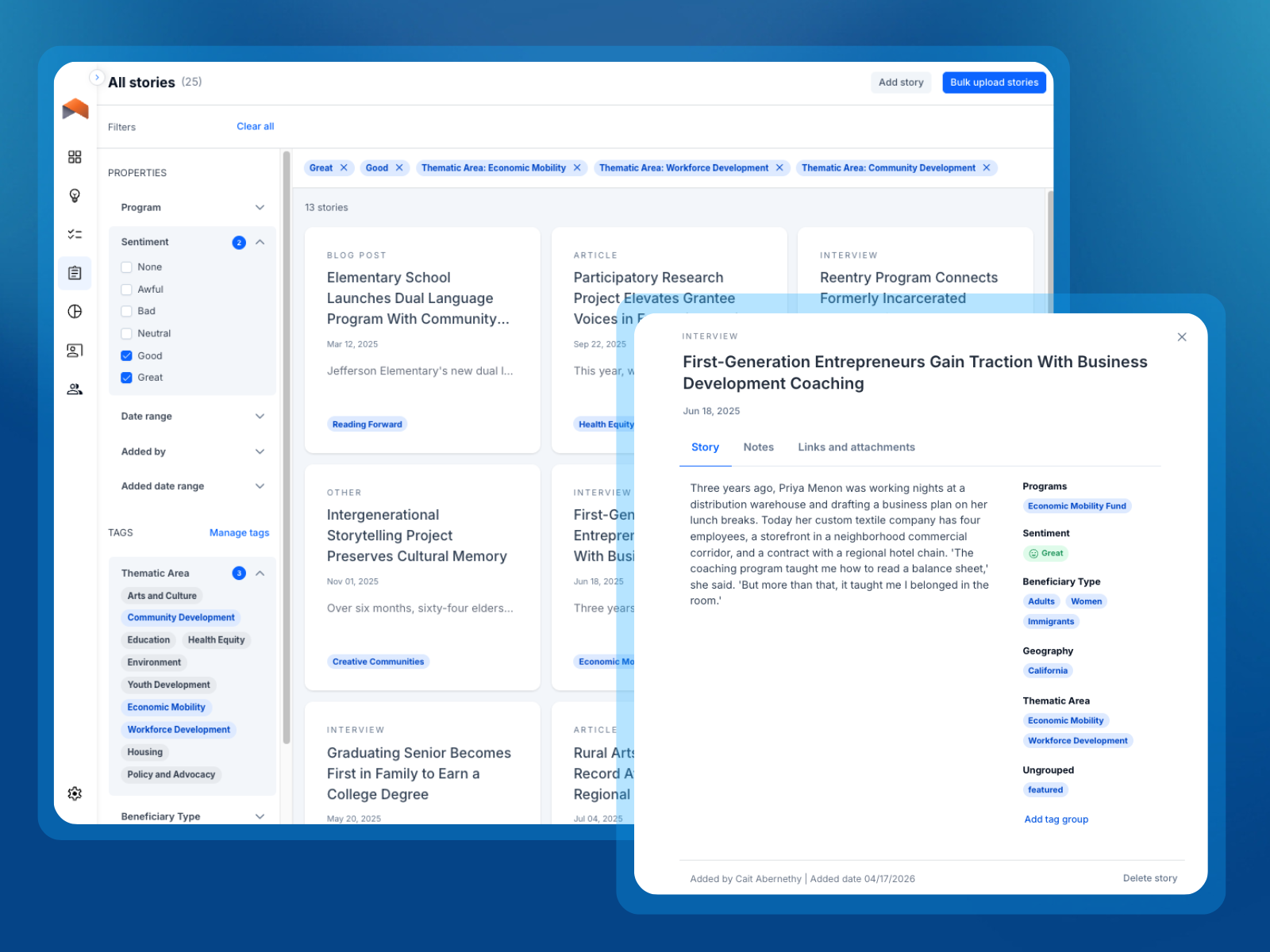
The process described in this post is exactly what UpMetrics' Stories functionality is built for. Stories lets you collect qualitative impact data from any source, then tag and categorize it directly inside the platform, so you're not exporting to a spreadsheet to do the analysis. Once your stories are tagged, that data flows into Advanced Analytics, where you can build charts and dashboards that turn your qualitative evidence into measurable, reportable impact. The bridge from story to evidence, built in.
Ready to put your coded data to work?
Coding your qualitative data is the turning point, but the job isn't done until that evidence reaches the right people in the right form. If you're thinking about how to present what you've found, these resources are a natural next step:
- The Ultimate Guide to Storytelling with Data Visualization — for turning themes and frequencies into visuals that actually land
- How to Design an Impact Report that Actually Gets Read — for building the report that carries all of it home
- Rethinking Reporting: A Guide for Impact Organizations — a deeper dive into what modern, learning-oriented reporting looks like in practice (free download)

%20-%20no%20button.png?width=1080&height=1200&name=Stories%20CTA%20Banner%20-%20Book%20a%20Demo%20(Vertical)%20-%20no%20button.png)