Theory of Change Software: A Guide for Impact Investors
As a fund manager, you sit squarely in the middle of a complex ecosystem: your limited partners (LPs) demand increasingly sophisticated impact reports, while these demands put additional strain on portfolio companies. Your internal impact team often lacks the time and tools to bridge this gap effectively, resorting to manual spreadsheets that risk human error and consume valuable resources.
To mitigate these risks, impact fund managers use theory of change software to track returns, automate data collection, and generate presentation-ready dashboards that LPs require. In this guide, we review the top features to look for in theory of change software and how to choose the platform that best suits your needs.
Theory of Change Software FAQs
What is an impact framework?
An impact framework is the overarching strategic resource impact investors use to define how they will measure, manage, and communicate their portfolio’s impact. For impact investors, it serves as the ultimate source of truth across the portfolio.
An impact framework serves these specific purposes:
- Track dual returns—both financial and impact—giving your fund a structured way to evaluate the success of pooled LP capital.
- Turn strategic intent into measurable outcomes before data collection begins, preventing the common mistake of retrofitting data to match reporting requests after the fact.
- Communicate your investment thesis and data strategy early in the fund's lifecycle, establishing the LP confidence necessary to secure future funding.
- Create a shared language across your fund and clearly define success upfront, helping your team turn social goals into a manageable process that guides every subsequent decision.
An impact framework is the umbrella category under which specific methodologies reside, including the theory of change, logic models, and social return on investment (SROI). Each of these methodologies approaches impact measurement differently.
What is a theory of change?
A theory of change is a specific impact framework that explicitly maps out long-term goals and backward-maps the necessary preconditions required to achieve them. Here are the key aspects of a theory of change impact framework:
- Explain the underlying causal mechanisms (i.e., the “why”) behind a portfolio company's impact, unlike a standard logic model that simply describes what you expect to happen.
- Surface the underlying beliefs, or assumptions, about why a hypothetical strategy will work in the real world.
- Account for external factors, known as moderators, that dictate exactly who benefits from the interventions.
- Define what falls within and outside your scope of influence, so you do not hold mission-driven businesses accountable for systemic shifts beyond their control.
- Serve as a living hypothesis that your portfolio managers continually test, update, and refine to make real-time investment decisions as data from your investees flows in.
A theory of change helps fund managers forecast outcomes more accurately using evidence rather than assumptions. This approach demonstrates to LPs that your capital actively advances your mission and wins their future support.
Why is it beneficial to have a theory of change?
Building a theory of change helps you approach impact investing strategically and confidently. Some specific advantages include:
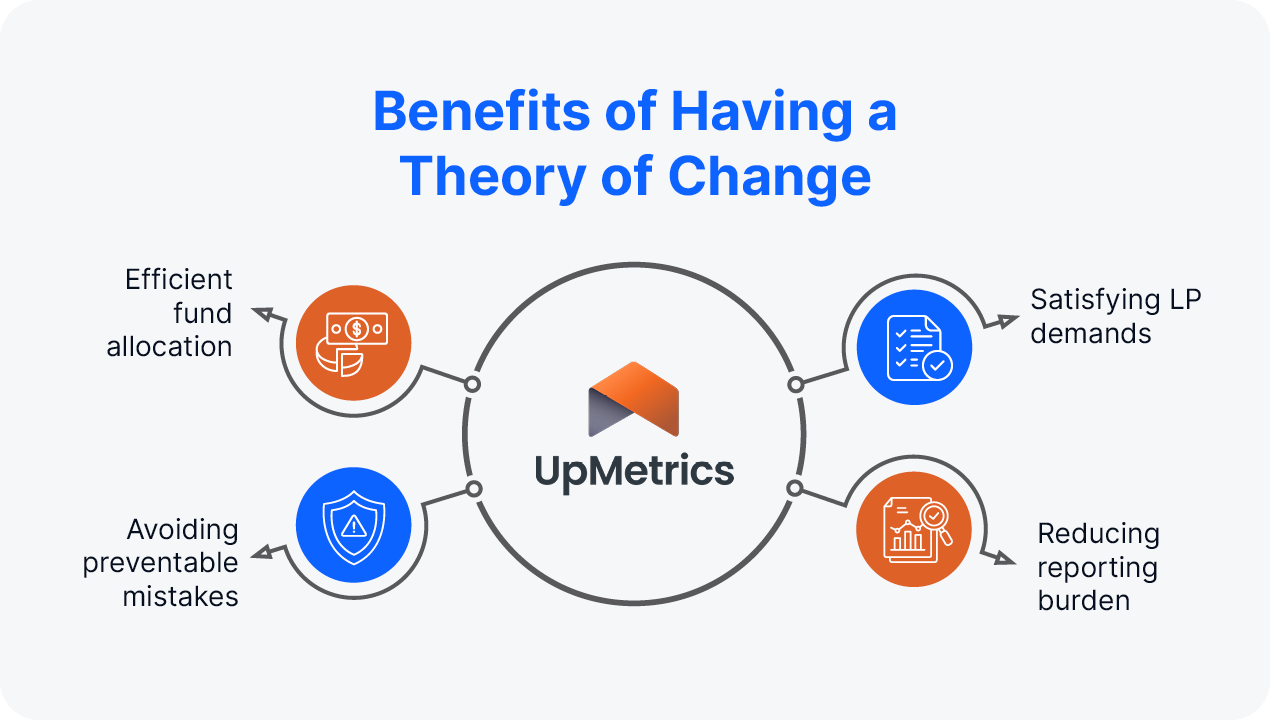
- Efficient fund allocation. Impact data keeps teams focused on high-ROI activities rather than chasing vanity metrics by mapping the logical linkages between daily actions and long-term outcomes.
- Satisfying LP demands. Impact investors increasingly require sophisticated, transparent data aligned with global standards. Documenting a transparent, causal link between invested capital and real-world outcomes eliminates any risk of overinflated reporting.
- Avoiding preventable mistakes and oversights. Integrating a theory of change into early underwriting allows fund managers to visualize the entire impact pathway and expose gaps and errors before deploying capital.
- Making reporting feel more meaningful. Showing funders exactly how their operational metrics feed into the fund's broader mission makes data requests feel like a purposeful partnership rather than an extractive compliance exercise.
Anchoring your entire data strategy in a clearly defined causal model protects your fund from mission drift. Every dollar invested and every metric collected serves a distinct, justifiable purpose that you can easily communicate back to asset owners.
How do you map a theory of change?
Mapping a theory of change involves identifying logical linkages between your actions and your long-term outcomes. Follow these steps to effectively map a theory of change:
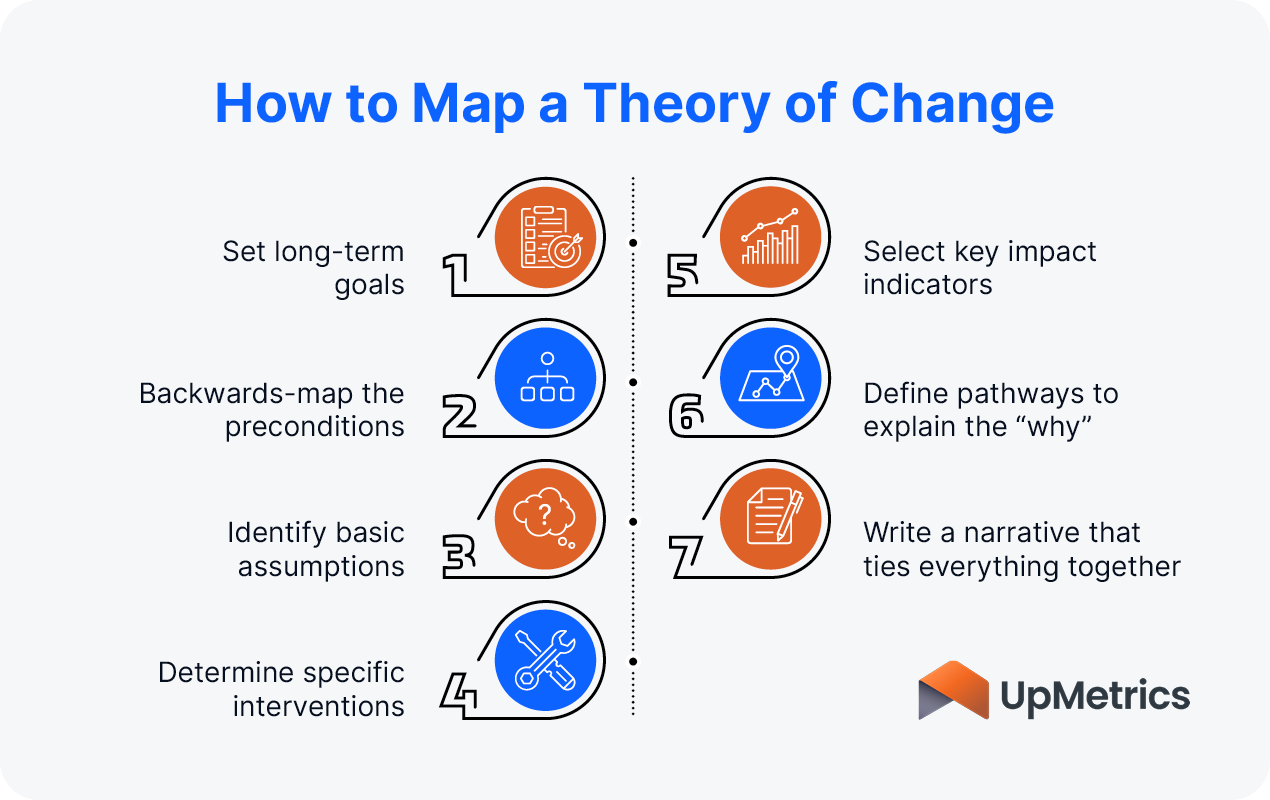
- Set long-term goals by defining the ultimate impact you wish to achieve across your portfolio.
- Backward-map the preconditions by detailing the specific requirements or intermediary steps needed to reach those overarching goals.
- Identify basic assumptions by documenting the contextual beliefs and environmental factors your firm is working within.
- Determine specific interventions by outlining the exact activities your initiative will enact to create the desired change.
- Select key impact indicators (KIIs) to accurately measure outcomes and assess your initiative's performance over time.
- Define pathways to explain the “why” by mapping the logic model elements within the platform. These pathways document exactly how inputs and activities directly connect to outputs and outcomes, showing your causal logic.
- Write a narrative that ties everything together, clearly explaining the initiative's logic in a digestible format for external stakeholders.
A theory of change should rely on a shared skeleton architecture with other impact frameworks. Use standard dimensions—inputs, activities, outputs, outcomes, and impact—to structure your data, house your overarching objectives within those dimensions, and nest your KIIs underneath.
What is theory of change software?
Theory of change software is technology designed to help fund managers visually map out their impact framework. Theory of change software helps fund managers:
- Explicitly document causal logic. The software actively maps the underlying "why" behind an investment strategy, connecting inputs and activities directly to desired outputs and outcomes, rather than just storing data.
- Improve alignment between fund managers and portfolio companies. Collaborative software gives portfolio companies clear visibility into their overarching impact goals, ensuring their on-the-ground activities align with the fund's long-term strategy.
- Tailor the framework to your specific portfolio. Theory of change software enables fund managers to map custom KIIs alongside global standards such as IRIS+ or the UN SDGs to satisfy LP demands.
Moving your framework from static documents to a dynamic, purpose-built tech stack makes it easier to manage both LP demands and portfolio company friction. It builds highly trackable, automated causal links that keep your entire portfolio aligned.
What’s the difference between impact reporting platforms and theory of change software?
For fund managers, the main difference lies in scope. Theory of change software helps you design your investment logic, while an impact reporting platform is the comprehensive engine that actively executes, tracks, and communicates that logic to your LPs and portfolio companies.
Other key distinctions include:
- Designing vs. operationalizing. Theory of change software helps fund managers map the causal logic of an investment strategy by identifying long-term goals and backward-mapping the preconditions required to achieve them. An impact reporting platform takes that defined strategy and operationalizes it across the entire five-step data lifecycle (define, collect, report, analyze, and leverage).
- Two-sided reporting. Theory of change software typically stops at framework design. An impact reporting platform actively manages the data collection process by providing portfolio companies with collaborative tools to track their progress and reuse data for their own needs, reducing reporting friction.
- Proving causal logic with live data. While standalone theory of change software lets you map out your expected impact, an impact reporting platform actively proves it. It takes your static causal logic and plugs in real-time data collected directly from your portfolio companies. This allows you to show LPs exactly how your actual investments are driving measured outcomes, rather than just showing them a theoretical map of what should happen.
Fortunately, fund managers don’t need to buy separate tools. A robust impact reporting platform (like UpMetrics) includes theory of change software features. Because the platform uses a framework-agnostic architecture, your team can seamlessly build a theory of change using its standard dimensions—Inputs, Activities, Outputs, Outcomes, and Impact. This allows you to easily house your overarching fund objectives and nest your custom KIIs beneath them.
Theory of Change Template
Features to Look For in Theory of Change Software
When evaluating theory of change software for your fund, focus on capabilities that solve real administrative roadblocks for portfolio companies. Look for these key features:
- Interactive canvas. For instance, UpMetrics’ Impact Framework Builder allows users to visually map pathways and nest KIIs directly under the logic nodes. The interface should be as streamlined as possible, avoiding coding or wrestling with static shapes.
- Flexible, customizable models. Find software with flexible dimensions that allow users to rename columns to match their exact theory of change language or map custom KIIs alongside impact reporting standards.
- Integration with a larger solution. It’s essential to have a tool that does more than just provide theory of change mapping functionality. Be sure to find a tool that can integrate with more robust reporting software.
Selecting the right features shifts your team's energy away from administrative maintenance and toward deep analysis.
How to Choose Theory of Change Software
Take a strategic approach to software selection by following these best practices:
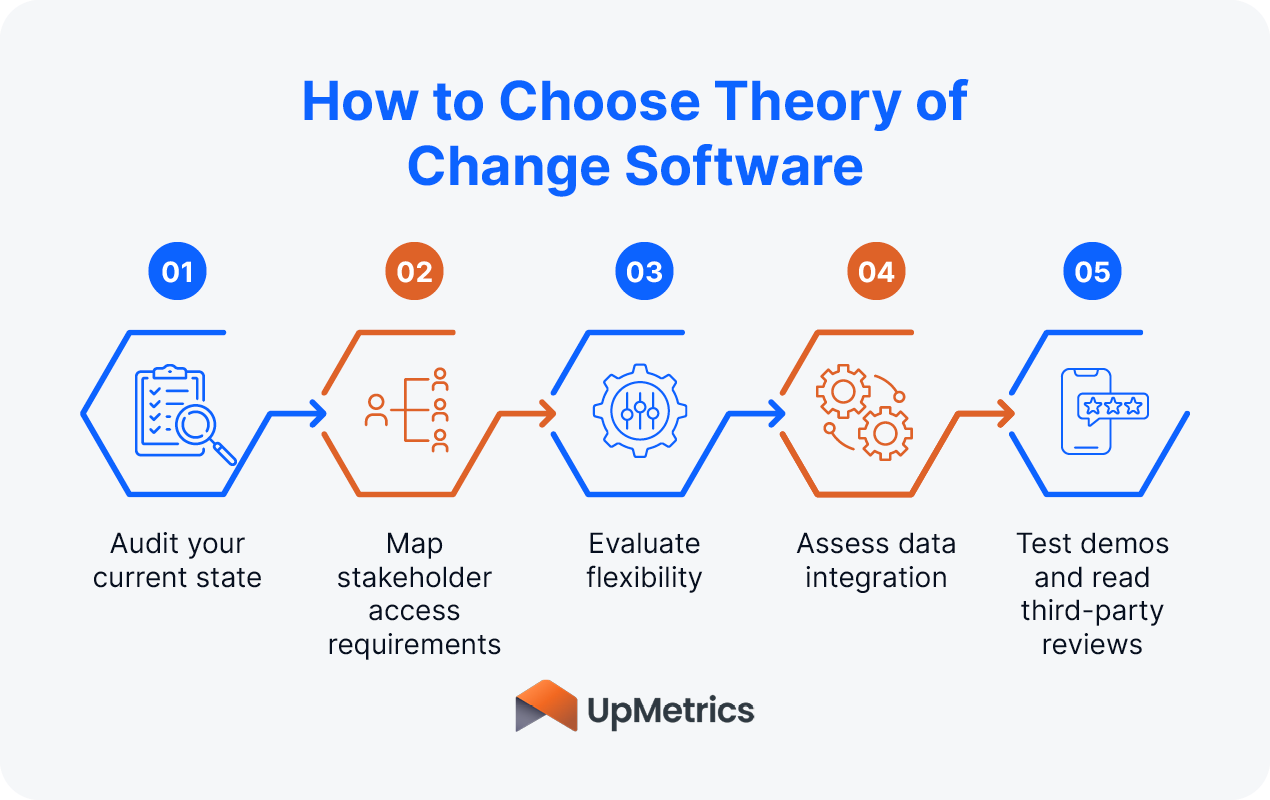
- Audit your current state. Before looking at vendors, map your operational scale. Do you have a single linear program, or do you manage a complex portfolio requiring nuanced logic models? Your software must match this architecture so you can aggregate your KIIs across different programs up to your organization-wide strategic goals.
- Map stakeholder access requirements. A theory of change is a collaborative process. List who needs to interact with the platform and define their access tiers. Look for intuitive user permissions, such as securely sharing view-only progress with external funders, and a two-sided reporting portal that enables portfolio companies and community partners to collaborate on data submissions.
- Evaluate flexibility. Test how easily a platform handles real-world updates. True theory of change software must allow you to adjust assumptions and update KIIs on the fly. If changing one link forces you to rebuild the entire map, it’s more likely that your team will abandon it.
- Assess data integration. Determine how evidence will actually get into the system. Check the platform's ability to connect to your existing data ecosystem (such as your CRM and grants management system). The platform should pull live metrics directly into your outcome tracks to reduce manual entry and establish a single source of truth.
- Test demos and read third-party reviews. Before committing, request a product demo to experience the interface firsthand and research independent third-party reviews to understand how other organizations perceive the platform's support and long-term reliability.
If you want to get the most out of your theory of change software, look past the point solutions.
We recommend using a full impact reporting platform so that you can not only build your theory of change, but also collect data and report on your progress, all in one place.
Why UpMetrics is the best impact reporting platform
UpMetrics provides the exact tools impact investors need to operationalize their theory of change. Here’s how we stand out:
- Purpose-built: Unlike general software, UpMetrics is tailor-made for impact investing operations and offers features that specifically address your needs, including:
- Accessible reporting portal that gives portfolio companies their own dashboards
- Theme-level and fund-level intelligence to aggregate and analyze impact across your entire portfolio
- Benchmarking tools to compare performance against your fund averages or investment thesis targets
- Presentation-ready dashboard generation that enables confident, LP-ready reporting
- Mutual value creation: UpMetrics creates value for both sides of impact investing, making reporting easier for submitters and more useful for requesters, fostering a collaborative ecosystem.
- Robust data security: UpMetrics prioritizes data integrity by maintaining SOC 2 Type 2 compliance, ensuring that sensitive information is protected by independently audited, enterprise-grade security standards.
- Comprehensive KIIs: Our agile platform allows impact investing organizations to accurately track tailored KIIs across any sector or specific cause area.
- Narrative-driven data: UpMetrics enables fund managers to combine quantitative metrics with qualitative data, taking a human-centric approach that helps funders and portfolio companies convey their missions through compelling stories.
- Expert support: Going beyond standard SaaS offerings, UpMetrics provides extensive hands-on services, including a comprehensive 120-day onboarding process and the Define+ program, which pairs organizations one-on-one with experts to build a custom impact framework.
UpMetrics removes the friction between your capital allocation and your impact narrative. Choosing a holistic solution that respects your causal logic and eases the burden on your portfolio companies gives you the clarity you need to lead with confidence.
For fund managers sitting between LPs and portfolio companies, the main risk at play is the execution gap. When your impact logic lives in a static PDF, and your actual metrics live in fragmented spreadsheets, you inherit an administrative burden that stifles fund performance and strains founder relationships.
The path forward requires treating your data architecture with the same rigor as your financial underwriting. By anchoring your strategy in a unified impact reporting platform, your visual framework ceases to be a theoretical map and becomes the structural backbone of your live data pipeline.